London: A Multi-Century Struggle for Sustainable Development in an Urban Environment
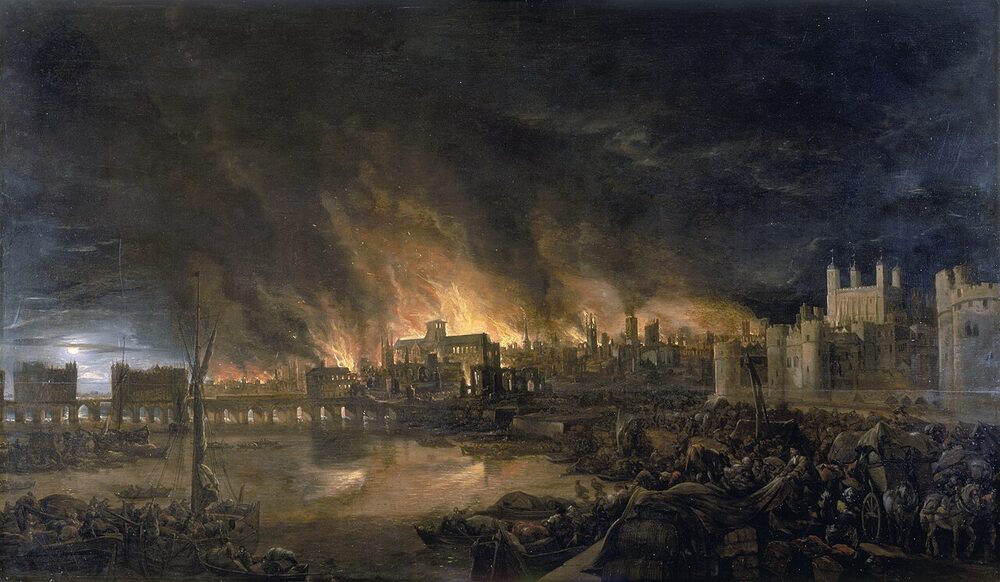
The Great Fire of London (anon., c. 1675), via Wikimedia Commons — public domain.
William C. Clark
This teaching case sketches key episodes in the two-thousand-year history of the interactions between society and environment that have shaped the City of London and its immediate hinterlands — from Roman settlement through plague, fire, fuel crises, and industrialization to the modern metropolis. The result is an empirical puzzle for use in teaching and theorizing about the long-term coevolution of social-environmental systems, and about how such systems might be guided toward sustainability. Frameworks for thinking about that coevolution have multiplied in sustainability science; empirical cases that actually span multi-decade to multi-century timeframes remain rare. London is one of them.
A companion piece, Looking Outward: Refocusing Attention on London’s Hinterland, extends the case beyond the city’s immediate surroundings to the distant places and resources on which the well-being of London’s people depended.
Using this case in the course
The London case is first assigned in Unit 1.4 (anthropogenic resources) and returns in Unit 2.1 (system dynamics), Unit 2.4 (horizontal connections), Unit 3.3 (measuring progress), and Unit 3.4 (adaptation). Each time we revisit the case, students see how new ideas from the course play out in a place they already know. And because the case spans generations, they see development on the time scale that sustainability actually involves.
Download
How to cite
Clark, W. C. (2015). London: A Multi-Century Struggle for Sustainable Development in an Urban Environment. HKS Faculty Research Working Paper Series No. RWP15-047, Harvard Kennedy School. Available from the Harvard Kennedy School.
© William C. Clark. Like any published paper, the case is under copyright by its author and provided open access — free to read, download, and assign in your own courses.