Looking Outward: Refocusing Attention on London’s Hinterland
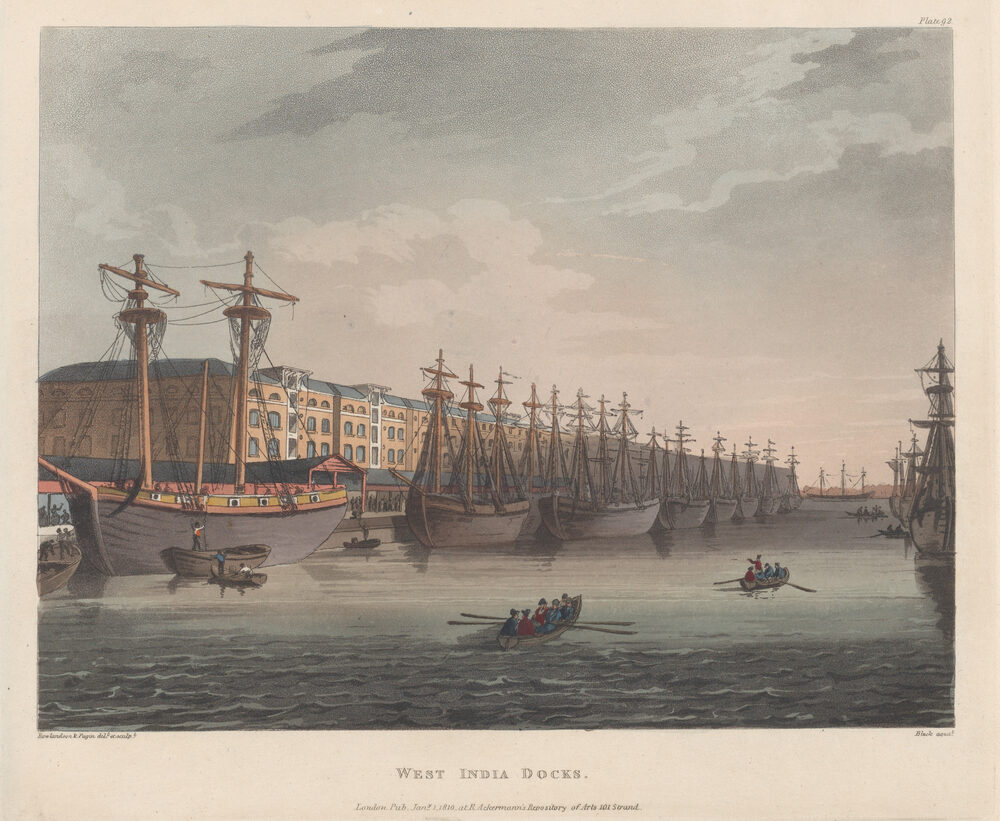
West India Docks (1810), The Met Collection — public domain.
Alicia G. Harley
This short companion to the London case was written after we realized that the case’s telling of London’s story had — perhaps a little too ironically — largely ignored a critical spatial dimension of the city’s development: the distant places and resources on which London relied as it grew. A city’s development pathway is never only local. The timber, sugar, grain, and labor that sustained London’s rise came from hinterlands that stretched, by the height of empire, across much of the globe — and many of the costs fell on those places too. The addendum refocuses attention outward, using London’s history to explore the horizontal connections among places (Unit 2.4) that any serious account of urban sustainability has to include.
A revised and expanded version of this addendum is in preparation and will appear as a working paper; this page will be updated with the formal citation when it is published.
Using this case in the course
The addendum is assigned in Unit 2.4 (horizontal connections), after students have worked with the main London case — the point in the course where the question becomes “sustainable for whom, and at whose expense?”
Download
How to cite
Harley, A. G. (2021). Looking Outward: Refocusing Attention on London’s Hinterland. Addendum to Clark, W. C., “London: A Multi-Century Struggle for Sustainable Development in an Urban Environment.” Course Library for Sustainable Development, Sustainability Science Program, Harvard University.
© Alicia G. Harley. Like any published paper, the addendum is under copyright by its author and provided open access — free to read, download, and assign in your own courses.