The Struggle for Sustainable Development in Appalachia’s Mineral Rich Mountains
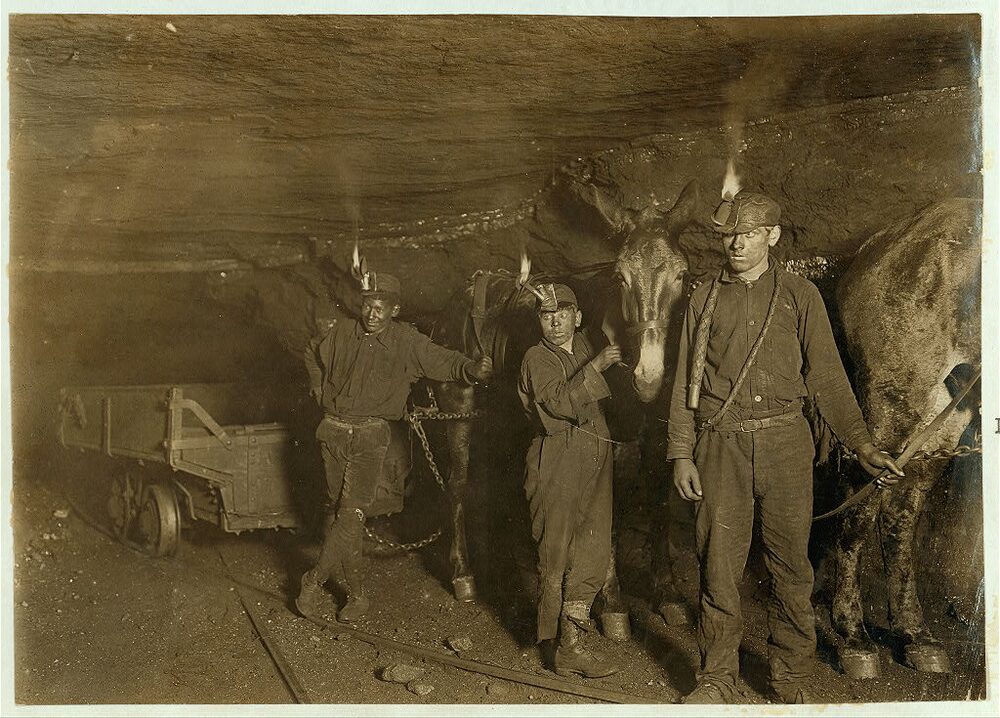
Child coal miners in a West Virginia mine, 1908. Photo: Library of Congress.
Alicia G. Harley and Hannah Wexner
This teaching case examines the paradox of poverty amidst plenty. It explores the co-evolving history of nature and society in Central Appalachia from the Native American period to the present, tracing how the discovery of the region’s abundant natural resources — timber, coal, and gas — shaped both its landscapes and its people. It is a history of inequality and the maldistribution of power, in which the wealth beneath the mountains flowed largely to distant owners while many of the costs stayed home. But it is not a story of passive victims: it is equally a history of resistance and struggle, of communities organizing to claim a larger share of the fruits of their region’s resources and a larger say in its future.
The case is written to support teaching and learning about sustainable development within messy, complex nature-society systems. It is particularly useful for examining how the unequal distribution of power among actors shapes development pathways (Unit 2.6) and for evaluating the capacities a region needs to pursue sustainability amid significant social and environmental challenges (Part 3 of the course).
Using this case in the course
The Appalachia case is first assigned in Unit 2.6 (actors, institutions, and power) — the unit its themes speak to most directly — and returns in Unit 3.2 (the capacity to promote equity) and Unit 3.7 (the capacity to transform development pathways). Each time we revisit the case, students see how new ideas from the course play out in a place they already know. And because the case spans generations, they see development on the time scale that sustainability actually involves.
Download
How to cite
Harley, A. G., & Wexner, H. (2022). The Struggle for Sustainable Development in Appalachia’s Mineral Rich Mountains. M-RCBG Associate Working Paper No. 184, Mossavar-Rahmani Center for Business & Government, Harvard Kennedy School. Available from the Harvard Kennedy School.
© Alicia G. Harley and Hannah Wexner. Like any published paper, the case is under copyright by its authors and provided open access — free to read, download, and assign in your own courses.