The Alaskan Salmon Fishery: Managing Resources in a Globalizing World
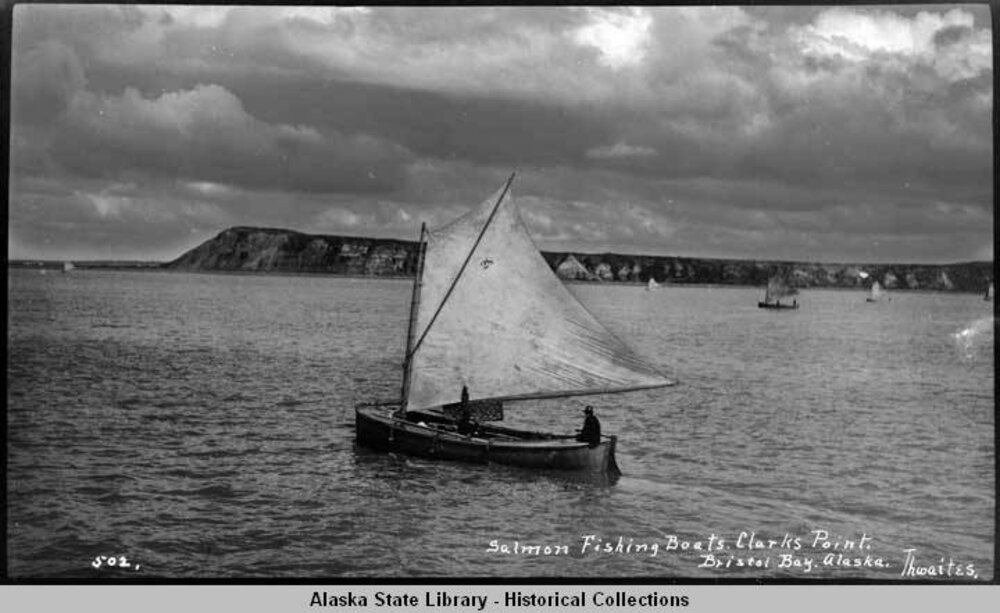
Salmon fishing sailboat at Clark's Point, Bristol Bay. Photo: Alaska State Library, John E. Thwaites Photograph Collection, P18-118.
The Alaskan salmon fishery is often held up as a model of successful, sustainable resource management — one of the few major fisheries to have avoided catastrophic collapse. This case looks at the harder story beneath that reputation. Alaska has long been imagined as “The Last Frontier,” a land of inexhaustible resources and untamed wilderness; the case traces how that perception collided with the realities of managing a living resource embedded in global markets — how a fishery that began as a source of local livelihoods became globally embedded, and what it has taken, and still takes, to manage extraction under the pressures of globalization and consumption demand.
The case pays particular attention to Bristol Bay and its famed sockeye fishery, using the region to examine knowledge production, environmental risk, and collaboration — and, through them, the impact of thickening connections and globalization on regional development.
Using this case in the course
The Alaska case is the first case students meet: it is assigned in Unit 1.1 as the opening test of the course’s framework for sustainability analysis, and returns in Unit 1.5 (integrated assessment), Unit 2.4 (horizontal connections), Unit 2.5 (vertical connections), and Unit 2.8 (synthesis). Each time we revisit the case, students see how new ideas from the course play out in a place they already know. And because the case spans generations, they see development on the time scale that sustainability actually involves.
Download
How to cite
Thompson, M. (2021). The Alaskan Salmon Fishery: Managing Resources in a Globalizing World. Course Library for Sustainable Development, Sustainability Science Program, Harvard University.
© Michaela Thompson. Like any published paper, the case is under copyright by its author and provided open access — free to read, download, and assign in your own courses.