Pursuing Sustainability in the Pearl River Delta: A Research Guide
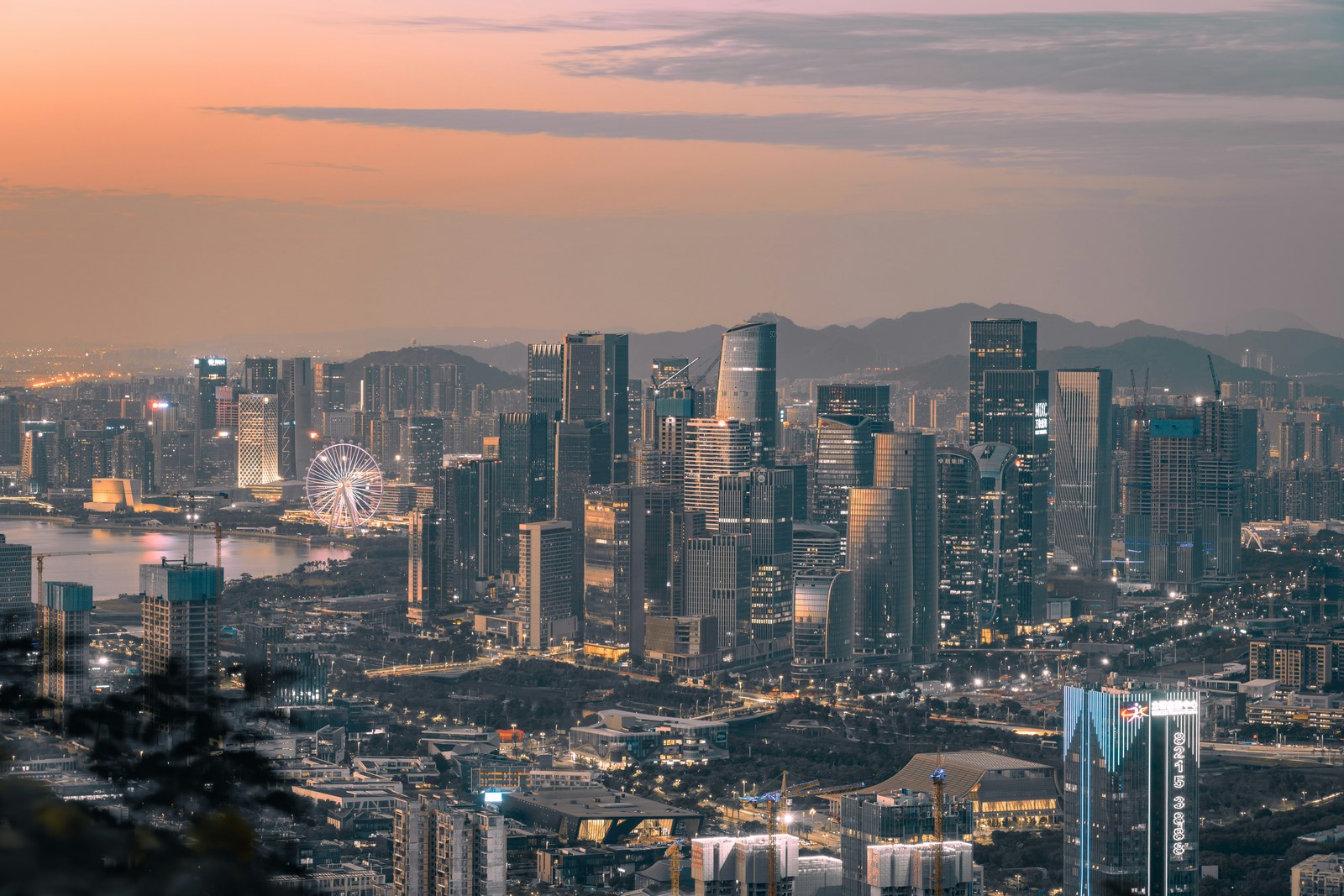
Qianhai, Shenzhen, at dusk. In 1979 Shenzhen was a market town of a few tens of thousands of people (Section 2); Qianhai today is a financial district rising on reclaimed land at the mouth of the delta. Photo: darmau / Unsplash.
How to Use This Guide
A central challenge in the pursuit of sustainability is how to integrate the general knowledge of core principles with the specific knowledge of local contexts to provide useful guidance for action on the ground. This research guide provides a foundation for applying the concepts and frameworks of the course to a concrete case: the Pearl River Delta of southern China, the world’s largest urbanized region, anchored by the cities of Hong Kong, Shenzhen, and Guangzhou. As you progress through the course, you can return to this case to apply new concepts and frameworks:
- In Part 1 (Sustainable Development as a Conceptual Challenge), you can use this guide to assess the region’s goals for sustainable development, the state of its resources, and the well-being of its people (Sections 1–4 below);
- In Part 2 (The Anthropocene as a Complex Adaptive System), you can analyze the complex dynamics of the delta’s nature-society system (Section 5);
- In Part 3 (Capacities Needed for the Pursuit of Sustainability), you can evaluate the region’s capacities for pursuing sustainability (Section 6).
It is critical to understand that this guide is only a springboard for your own inquiry into the Pearl River Delta. Your job is to become well-versed in the region and its potential to effectively pursue sustainability. That requires critically reading this document and the linked citations, delving deeper into the available literature on the delta, and exploring the broader literature in sustainability science and related fields. In the age of artificial intelligence, assembling and summarizing what has already been written about a place has never been easier. What remains scarce is different: new knowledge about the region itself (your interviews will generate a little of it), and the ability to put the many parts together—goals, resources, well-being, system dynamics, capacities—into useful guidance for actual progress toward sustainability. That work of integration is what this case asks you to practice. Many of the mistakes that actors make in designing interventions to meet sustainable development goals involve a failure to fully grasp the complexity of the nature-society system in which they hope to intervene. You should be prepared to defend your chosen supporting evidence; this means conducting thorough, thoughtful research and analysis and using credible, well-chosen sources.
This guide is structured as follows:
- A brief introduction to the Pearl River Delta case, including how actors in the region have framed their own sustainability goals.
- A look at the historical context that sets the stage for the modern-day pursuit of sustainability in the region.
- A descriptive overview of the state of human well-being in the Pearl River Delta today.
- A brief exploration of the resource base—natural and anthropogenic—in the region today.
- Some links to interesting examples of complex nature-society system linkages in the delta, to give you a feel for the complexities of the region.
- Questions to guide your assessment of the region’s capacities for pursuing sustainability.
- A note on expert interviews, with a pointer to the course Interview Guide.
1. The Pearl River Delta Case: Context and Goals
This case involves the interactions of society and environment in the world’s largest urbanized region, the Pearl River Delta (PRD). The PRD is a part of southern China that surrounds the estuary of the Pearl River in Guangdong Province. It includes nine cities, namely Guangzhou, Shenzhen, Zhuhai, Foshan, Dongguan, Zhongshan, Jiangmen, Huizhou, and Zhaoqing. Together with the two neighboring Special Administrative Regions of China—Hong Kong and Macao, which are governed under separate legal and economic systems within one country—these eleven jurisdictions form a single functional region, and this case treats them as such.
A note on names, because the sources you will read use several. For two decades the eleven-jurisdiction region was called the “Greater Pearl River Delta,” a concept as well as a vision regarding the integration of the economic and social development of the PRD cities along with Hong Kong and Macao. In 2019 the Chinese central government relaunched that vision under a new name, the “Guangdong-Hong Kong-Macao Greater Bay Area” (GBA), and the older term has largely disappeared from official documents. Earlier editions of this guide used “Greater PRD” throughout; current government material says “Greater Bay Area”; the academic literature uses both, depending on when it was written—all referring to the same region. This guide uses “Pearl River Delta” or “the delta” for the region and “GBA” when referring to the official framework.
The region is situated in a transitional zone of the East Asian monsoon system. The mean temperature in January ranges from about 13 to 15 degrees Celsius (55 to 59 degrees Fahrenheit). Summer is the main raining season and the annual precipitation totals more than 1,600 millimeters (63 inches). The whole region covers about 56,000 square kilometers (21,600 square miles), which is about the size of Maryland and New Jersey put together. Its population is about 87 million people—more than Germany’s—and its combined economic output in 2024 was roughly 14.8 trillion yuan (about US$2.1 trillion), comparable to the GDP of Italy.
As the largest urban agglomeration in the world, the sustainability issues that the region faces are deeply embedded in its urban context. For instance, one of the first challenges that the region encountered was population growth, driven in part by the gradual movement of manufacturing industries from Hong Kong to the PRD starting in the 1980s. Alongside the increase in population was the expansion of the urban landscape, including conversion of rural farmland to urban land. In turn, migration, urban population growth, and provision of critical resources—such as water, education, public transportation, and housing—are all important to the region’s sustainable development.
How has the region framed its own goals? In 2009, a consensus was reached between the governments of Guangdong, Hong Kong, and Macao regarding a plan to build a “quality living area” in the region. The notion was adopted to underscore that the region’s sustainable development goals aimed to balance economic and social development along with the environment. In the regional cooperation plan prepared for this purpose, approaches to pursue sustainability in the region were further specified and included five goals:
- Bringing about a clean and safe ecological system and natural environment;
- Steering economic development along a low-carbon and sustainable pathway, and fulfilling the needs of the residents in terms of employment and consumption;
- Providing more convenient public services and adequate livelihood security;
- Well-planned spatial development and a pleasant living environment; and
- Establishing a green, highly efficient, and people-oriented transportation system to facilitate convenient cross-boundary connections.
The current framing of regional goals is the Outline Development Plan for the Guangdong-Hong Kong-Macao Greater Bay Area, published by the central government in February 2019. It sets out five “strategic positionings” for the region: a vibrant world-class city cluster, a globally influential international innovation and technology hub, an important support pillar for the Belt and Road Initiative, a showcase for in-depth cooperation between the mainland and the two Special Administrative Regions, and—in language that carries the 2009 vision forward—”a quality living circle for living, working and travelling.” The list mixes innovation-led growth, national strategic aims, and quality of life. Part of your work as an evaluator is to ask how these goals relate to each other in practice, and what happens when they pull in different directions.
Although the region is working towards creating a more sustainable future together, each of the jurisdictions also has a parallel effort to create its own plans. The nine mainland cities closely follow the guidelines and policies of the Chinese central government, while Hong Kong has developed its own plans based on its priorities under the “one country, two systems” structure—including a territorial development strategy (Hong Kong 2030+) and a Climate Action Plan 2050 that commits the city to carbon neutrality before 2050. The Chinese central government has been issuing Five-Year Plans since 1953 to communicate top priorities in economic and social development; the 14th Five-Year Plan (2021–2025) gave the GBA a prominent role, and the 15th (2026–2030), adopted in March 2026, continues it. Under China’s “dual carbon” goals, announced in 2020, national emissions are to peak before 2030 and reach carbon neutrality before 2060.
Citations:
- Central Committee of the Communist Party of China and State Council. 2019. Outline Development Plan for the Guangdong-Hong Kong-Macao Greater Bay Area. (The Hong Kong government’s Greater Bay Area site collects the framework documents.)
- Governments of Guangdong, Hong Kong, and Macao. 2011. Regional Cooperation Plan on Building a Quality Living Area.
- Government of the Hong Kong Special Administrative Region. 2005. A First Sustainable Development Strategy for Hong Kong.
- Hong Kong Planning Department. 2021. Hong Kong 2030+: Towards a Planning Vision and Strategy Transcending 2030.
- Government of the Hong Kong Special Administrative Region. 2021. Hong Kong’s Climate Action Plan 2050.
- Government of China. 1994. China’s Agenda 21: White Paper on China’s Population, Environment, and Development in the 21st Century.
- Government of China. 2021. Outline of the 14th Five-Year Plan for Economic and Social Development (2021–2025). (For a short orientation to the Five-Year Plan system, see the Congressional Research Service’s “China’s 14th Five-Year Plan: A First Look.”)
2. Historical Context
The Pearl River Delta is one of the most competitive economic regions in China and in the world. Although today it is perceived as being economically, environmentally, and socially connected, the path of its historical development has exhibited both divergence and convergence. Throughout this guide we will often focus on Hong Kong, Macao, and Guangzhou as representative instances of sustainability efforts in the region, but you should not feel that you need to constrain your research to these cities alone (please note, however, that English-language resources may be more difficult to find for other cities).
Macao transformed from a fishing village to an international commercial port much earlier than Hong Kong. The arrival of the Portuguese on the island in 1553, and their subsequent bribes to local officials, allowed them to conduct trading activities in the area. These bribes later developed into a permanent settlement agreement, which legalized Portuguese trading through the formation of a lease and rental payments to the Chinese government. The Portuguese settled down on the island, though their settlement and control of Macao did not involve a transfer of sovereignty for a long period of time. Macao was later officially taken by the Portuguese after the First Opium War ended.
On the other hand, Hong Kong’s rise was directly connected to the First Opium War and the Treaty of Nanking. Through the Treaty, Hong Kong Island was ceded to Britain in 1842. Furthermore, the Second Opium War and the Convention of Peking mandated that the Qing government give away part of the Kowloon Peninsula to Britain. The part of Hong Kong known as the New Territories today was later leased to Britain in 1898. Overall, the colonization of Hong Kong by the British placed great influence on trade in China, and during the 1870s and 1880s, about one-fifth of China’s exports and one-third of its imports were transited through Hong Kong.
During the years between 1757 and 1842 (prior to the First Opium War), Guangzhou was the only city on the mainland side where foreign trade was allowed. Guangzhou’s old name, Canton, together with this “single port commerce system,” or Canton System, became well-known throughout the world. Accordingly, Guangzhou’s central economic status in the region was cemented.
After the establishment of the People’s Republic of China in 1949, Hong Kong (which remained under British administration until 1997) replaced Macao as the more economically advanced harbor on the outer circle, while also partially taking over Guangzhou’s core role on the eastern part of the estuary. Guangzhou and Hong Kong came to stand out as the two cores in the region and formed a bi-polar spatial economic structure.
In the first few decades of the People’s Republic, the economy of the region continued to be dominated by this dual-core model, where each city had a differentiated focus. On one hand, Guangzhou’s performance on industrial output in 1952 was not only the highest in the PRD, but also surpassed the total of all the cities in Guangdong outside the PRD. In addition, from 1958, the focus of the economy in all of China was increasingly placed on heavy industry. This shift promoted the construction of a large number of state-owned enterprises related to the iron and steel, cement, and chemicals industries. However, it undermined the region’s previous tradition and structure around agriculture and resulted in a relatively low growth rate for gross industrial output. On the other hand, the British administration in Hong Kong converted what was once a fishing county into a modern world city in Asia with a concentration on service industries. This process was partially helped by capitalist emigrants from the mainland, for instance from Shanghai, who were afraid of communist control. These immigrants brought not only a new source of labor to Hong Kong, but also large amounts of investment. By the end of the 1960s, output value from manufacturing accounted for 30 percent of Hong Kong’s GDP. As the manufacturing industry flourished, other industries—including transportation, real estate, telecommunications, tourism, and finance—also grew significantly.
New dynamics emerging in the late 1970s began to change the dual-core structure. By the end of the 1970s, Hong Kong had become industrialized, but high costs for both labor and rent started to constrain the manufacturing industry in the local region. The opening-up reforms in mainland China, starting in 1978, gradually introduced market principles into the Chinese economy. This offered cities in the PRD—including Shenzhen and Zhuhai, which became special economic zones in 1980—opportunities to take up similar industries to Hong Kong and Macao by leveraging their competitive prices in labor and land. In 1984, Guangzhou was listed as a coastal open city, and in the following year, the Pearl River Delta economic zone was established. It included four cities and twelve counties in the initial stage and then later expanded. In addition, policies from the Chinese central government supported the relocation of industries from Hong Kong and Macao to the mainland. Meanwhile, Hong Kong and Macao became the largest sources of foreign investment in the PRD. Overall, the agglomeration of megacities in the region today is a direct result of the urbanization driven by this industrialization process. Shenzhen, a market town of a few tens of thousands of people in 1979, is today a city of more than 17 million and one of the world’s leading centers of technology manufacturing (Section 4.3).
With the deepening industrialization of the PRD, the economic structure became increasingly poly-centric. Each of the cities in the region developed its own specialization, and as a group, the cities began to complement each other in their respective functions. The handover of Hong Kong and Macao to the Chinese government in 1997 and 1999, respectively, widened the possibility for regional cooperation and coordination. In this way, the “Greater Pearl River Delta” was invented as a conceptual tool to promote further integration in the region. In addition, Hong Kong and Macao each signed a Closer Economic Partnership Arrangement (CEPA) with the central government in 2003. With the CEPA in place, a new division of labor between Hong Kong and the PRD unfolded, composed of a three-part chain of industries: upstream, midstream, and downstream. For example, the service industry, which is part of the upper stream, accounted for more than 80 percent of Hong Kong’s GDP. Both Hong Kong and the PRD contribute to the downstream segment, with Hong Kong being the front desk for advertising and sales while the PRD serves as the back office for logistics and training.
Structural changes in the economic production of the region have also created both challenges and opportunities for the region to pursue environmental sustainability. The landscape once featured rice paddy fields, sugar cane, culturing ponds for fish, and other similar uses that corresponded to the dominance of the traditional agricultural economy. The transition to the industry- and services-oriented economy has, accordingly, transformed patterns of land use. Specifically, built-up areas for industrial, commercial, and residential uses have, to a large extent, replaced the rural-agricultural lands. For example, the overall built-up area of the PRD increased by 134 percent between 1992 and 2001 alone.
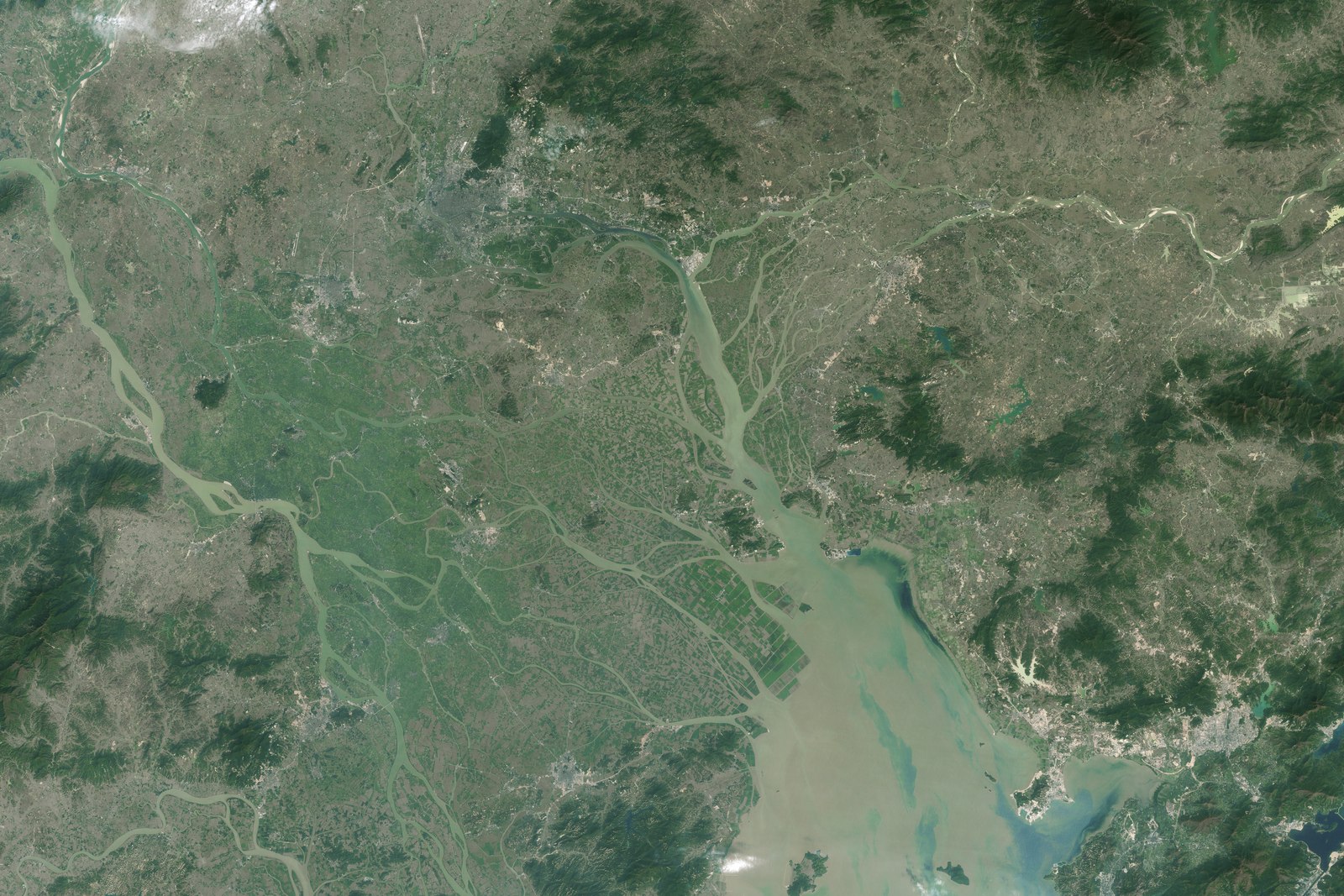
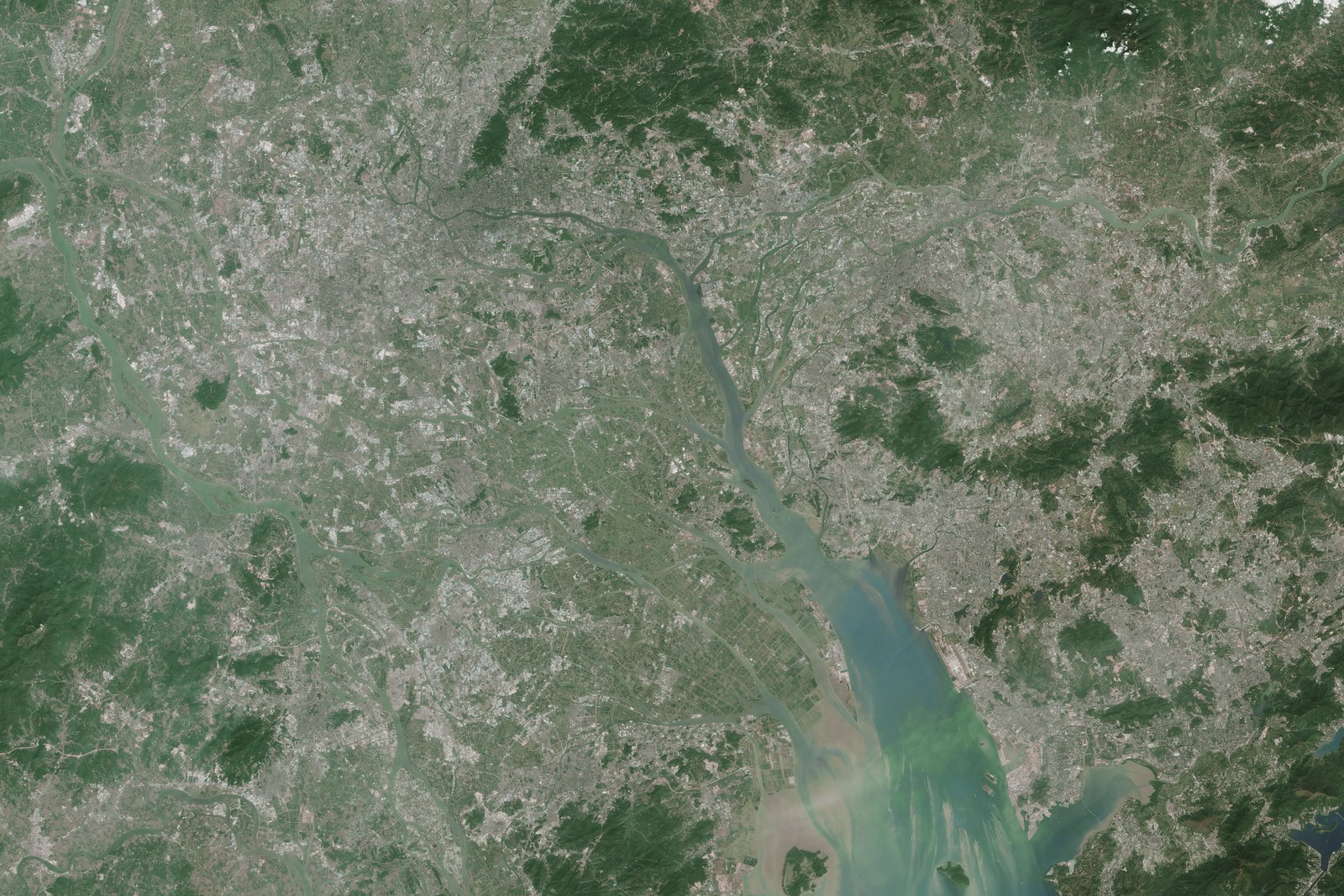
The delta seen by Landsat in November 1988 (first image) and November 2014 (second). In 1988 the estuary is still ringed by farmland and fish ponds; by 2014 built-up land is nearly continuous around it. Images: NASA Earth Observatory (Joshua Stevens), using Landsat data from the U.S. Geological Survey.
Such change has also shaped the way humans interact with nature and with each other. In the case of water, pipes and taps—providing an easy and convenient daily supply of treated, clean water—have replaced the previous practice of directly accessing water from lakes or rivers. In terms of social relations, the concept of “villages-in-the-city” captures the complex networks and relationships between the large number of yearly migrants and the old urban dwellers. To address some of these issues, in 2009, Guangdong, Hong Kong, and Macao jointly released the coordination plan described in Section 1, focused on infrastructure and transport networks, in the hopes that such infrastructure would help promote integration across the region along a number of dimensions. The 2019 Greater Bay Area plan is the successor to that effort, at much larger ambition and with the weight of the central government behind it.
The region’s political institutions have also changed substantially since 2019, above all in Hong Kong. In 2019, a proposed extradition law set off months of mass protests in Hong Kong, the largest in the city’s history. In June 2020, China’s national legislature imposed a national security law on the city, criminalizing secession, subversion, terrorism, and collusion with foreign forces. In the years since, more than 300 people have been arrested under the security laws, including most of the leadership of the former opposition: 45 pro-democracy figures were sentenced in November 2024 to prison terms of up to ten years for organizing an unofficial election primary, and the newspaper publisher Jimmy Lai was convicted under the security laws in December 2025 and sentenced in February 2026 to 20 years. Hong Kong passed additional security legislation of its own—the Safeguarding National Security Ordinance, required under Article 23 of its Basic Law—in March 2024. An electoral overhaul in 2021 restructured the Legislative Council so that only 20 of 90 seats are directly elected and all candidates are vetted for “patriotism”; turnout in the subsequent Legislative Council elections (30.2 percent in 2021, 31.9 percent in 2025) fell to roughly half of what it had been in 2016. These changes were accompanied by significant emigration: roughly 180,000 Hong Kong residents were granted British National (Overseas) visas between 2021 and early 2025, and the city’s population fell by more than 200,000 between 2019 and 2022 before rebounding—driven largely by new arrivals from the mainland under talent-admission schemes—to about 7.5 million at the end of 2025. Meanwhile the border between Hong Kong and the mainland, effectively closed for nearly three years during the COVID-19 pandemic, fully reopened in early 2023, and daily cross-boundary flows resumed and in some categories exceeded pre-pandemic levels. Official accounts present these changes as restoring stability after the 2019 unrest; critics say they ended the civic freedoms that distinguished Hong Kong within China. It is especially important here to read official sources as well as the critical literature. The institutional facts themselves—the laws, the cases, the election rules, the migration numbers—are not in dispute, and any serious analysis of the region’s pursuit of sustainability has to take them into account (Sections 4.4 and 6).
Citations:
- Bie, Jiangbo, Martin de Jong, and Ben Derudder. 2015. “Greater Pearl River Delta: Historical Evolution towards a Global City-Region.” Journal of Urban Technology 22(2):103–123.
- Wang, Vivian, Austin Ramzy, and Tiffany May. 2021. “With Mass Arrests, Beijing Exerts an Increasingly Heavy Hand in Hong Kong.” New York Times.
- ChinaFile. Tracking the Impact of Hong Kong’s National Security Law. (A running, sourced database of arrests and prosecutions.)
- Al Jazeera. November 19, 2024. “Hong Kong jails 45 pro-democracy activists in largest security case.”
- Government of the Hong Kong Special Administrative Region. March 2024. “Article 23 legislation effective March 23.”
- South China Morning Post. 2025. “163,400 Hongkongers arrive in UK under BN(O) visa scheme since 2021.”
3. Human Well-Being in the Pearl River Delta
The indicators examined in this section capture the constituents of well-being—the dimensions people actually experience as quality of life, such as health, education, income, and living conditions. As you explore in Unit 1.2 of the course, these differ from the determinants of well-being—the resources examined in Section 4—that enable societies to produce well-being outcomes. In other words, constituents are the ends we seek (what people actually experience), while determinants are the means (the resources societies draw upon to achieve those ends).
There are many factors that contribute to human well-being. For instance, as discussed in the course readings, the OECD’s Better Life Initiative has identified 11 topical areas as particularly important to human well-being. Along these lines, this section considers economic activity, health, and inequality as three potential contributors. In addition, given that country-level statistics can often mask local variation, this discussion explores these factors as they apply both to China and to the delta (when data on the latter are available). Please remember that this is by no means a comprehensive list of the data available on well-being in the region, and you should delve deeper into this topic.
First, economic activity—as measured by gross domestic product (GDP)—has increased extraordinarily. Over the period 2000 to 2012, the region’s GDP grew at an average annual rate of over 11 percent; by 2012 it stood at about US$1.1 trillion, equivalent to the world’s 16th-largest economy, with a per capita GDP of about US$13,400. By 2024 the combined GDP of the eleven jurisdictions had roughly doubled from that level, to about 14.8 trillion yuan (US$2.1 trillion)—comparable to Italy, and larger than all but about ten national economies. Guangdong Province, of which the nine PRD cities produce over 80 percent, has been China’s largest provincial economy for 36 consecutive years. Hong Kong’s GDP was about US$408 billion in 2024, its third consecutive year of growth after the pandemic downturn. Macao’s economy, uniquely dependent on casino gaming, collapsed during the pandemic and has recovered to roughly 85 percent of its pre-pandemic gaming revenue; its government is pursuing a diversification strategy (“1+4”) whose actual progress is worth examining critically. Although GDP is an incomplete measure of well-being, it serves as one indicator of the region’s development.
With regards to health, gains have been substantial but also unequal. Over the period 1960–2024, average life expectancy in China increased from 43 years to 79 years. Hong Kong’s is the highest in the world: 88.2 years for women and 82.7 years for men (2024). The Gallup-Sharecare Well-Being Index, which considers five elements that determine human well-being, evaluated China (among other countries) on a “physical” component that encompasses health as well as general energy level; the country as a whole has made substantial improvements along this dimension, though such gains have not accrued to the oldest and the poorest in the same way they have for other segments of the population.
Lastly, patterns of inequality can also be seen in GDP and income, as the poly-centric economic structure of the region has not ensured equal development. For example, the Gini coefficient for per-capita GDP between the PRD and the rest of Guangdong increased from 0.19 in 1978 to 0.36 in 2003. For this reason, compared with the rest of Guangdong, the PRD is regarded as the core (and has much higher per-capita GDP) while the remainder is seen as the periphery. At the same time, there is also inequality within the delta itself. In Hong Kong, the Gini coefficient for household income reached 0.539 in 2016—the highest figure since the city began keeping records on income inequality, and still the most recent census-based figure for original income; the 2021 census put the coefficient at 0.397 after taxation and social transfers, a number worth comparing carefully with the pre-intervention figure when you assess redistribution in the city. Hong Kong has also been ranked the world’s least affordable major housing market for sixteen consecutive years (Section 4.3 examines housing directly). Overall, it can be said that the advancement in economic development in the region has been realized, to a greater or lesser extent, at the price of polarization. For all of these reasons, human well-being in the region should be analyzed critically.
Citations:
- Gallup. 2015. “China Faces Challenges in Promoting Physical Well-Being.”
- Lu, Lachang, and Yehua Dennis Wei. 2007. “Domesticating globalisation, new economic spaces and regional polarisation in Guangdong Province, China.” Tijdschrift voor economische en sociale geografie 98(2):225–244.
- Yau, Cannix, and Viola Zhou. 2017. “Wealth gap in Hong Kong hits record high.” South China Morning Post.
- Hong Kong Census and Statistics Department. 2022. Household Income Distribution in Hong Kong (2021 Population Census thematic report).
- South China Morning Post. 2023. “Greater Bay Area economy almost as big as Italy’s.”
- South China Morning Post. 2025. “Life expectancy for Hong Kong women hits record.”
4. The Productive Base: Resources in the Pearl River Delta
The ultimate determinants of the region’s ability to achieve its sustainability goals are its stocks of resources—the “fuel in the tank” on which each generation can draw to generate the flow of goods and services it consumes in pursuit of well-being. As in the course, we divide these resource stocks into two groups: those provided by nature (natural resources, Unit 1.3) and those provided by people (anthropogenic resources, Unit 1.4). Together they constitute the necessary—but, as we will learn, insufficient—ingredients for improving human well-being. (Terminology note: much of the literature follows the economists in referring to “capital” and “assets” rather than to “resources.” The more general term we have come to prefer is “resources”—but in the context of sustainability analysis, all of these terms can be taken to mean the same thing.)
Working definitions of the resource stocks:
- Natural resources: the foundations (land and water); materials (hydrocarbons, metals, and other minerals); and life (biomass and biodiversity)—together with the ecosystems, climate, and biogeochemical cycles in which they are embedded.
- Anthropogenic resources, conventionally grouped as:
- Human capital: people—their health, education, and numbers—as a means (rather than an end) of sustainable development;
- Manufactured capital (also called “produced capital”): human-made systems of roads, buildings, ports, machinery, telecom hardware, pharmaceuticals and personal “stuff”;
- Social capital: trust, norms, and institutions—often more difficult to measure than stocks of natural resources or manufactured capital in a region (not that those don’t present their own challenges);
- Knowledge capital: understanding of how the world is that is codified in books, journals and patents, as well as experiential and indigenous knowledge that is widely shared among people, whether written down or passed on orally. Methods of measuring knowledge capital remain difficult, but there are efforts out there to try to quantify this stock.
In order to understand how these resource stocks generate human well-being in the Pearl River Delta, you must begin by understanding the current state of each resource in the region (i.e. how much of a given resource is there). In addition, it is important both to understand the historical trends and to gauge the trends moving forward (e.g. human capital is increasing and will likely continue to increase because early childhood nutrition has improved and rates of infant mortality have declined).
Here, we provide a brief narrative overview and a few links to research to orient you to the state of and trend in each of the resource stocks in the region. Remember that this is just a sample of the available data and research.
4.1 Natural Resources
Although the region has increasingly focused on service and technology industries, such changes do not mean that the management of natural resources has become any easier. This section examines water, air, the delta’s coastal ecosystems, and the changing climate.
First, consider water in Hong Kong. Amongst the various materials and resources that Hong Kong imports from the mainland, water is perhaps the most important. Since 1965, Guangdong has provided freshwater to Hong Kong via the East River (Dongjiang in Chinese). In recent years, the volume of freshwater Hong Kong has received from the mainland has amounted to 70–80 percent of its total freshwater supply (with the remainder coming from local catchments). The East River itself, however, is under stress from industrial development, urban expansion, population growth, and climate change—it also supplies Shenzhen, Dongguan, Huizhou, and other cities, so Hong Kong is one claimant among tens of millions. The supply agreements, renegotiated every three years, are structured as a package deal: under the current agreement (2024–2026, about HK$15.8 billion over three years) Hong Kong pays for the right to draw up to 820 million cubic meters a year, with a “deductible sum” arrangement, introduced in 2021, that reduces the payment when local yields allow the city to draw less. A guaranteed supply purchased at a fixed price potentially discourages water conservation, and Hong Kong’s consumption is in fact high: in 2013 average consumption per capita was 220 liters per day, 30 percent higher than the world average at the time, and domestic freshwater use remains about 121 liters per person per day (2023–24)—on top of which the city flushes with seawater through a separate distribution network. In December 2023 Hong Kong commissioned its first desalination plant, at Tseung Kwan O, which can meet about 5 percent of freshwater demand (expandable to 10 percent)—a hedge against drought, bought at higher cost and energy use than river water. Section 5 returns to the water system as a worked example of nature-society dynamics.
The region also coordinates its air pollution control efforts. Primary emissions sources include power plants, industry, vehicles, and marine vessels. For Hong Kong, air pollution is caused not only by emission sources in the city itself, but in some cases by sources beyond it; in this way, air pollution is not just a local issue but one that requires management across a broad geographic area. Since 2005 a joint monitoring network run by the Guangdong and Hong Kong governments (Macao joined in 2014)—still called the Pearl River Delta Regional Air Quality Monitoring Network, one of the places the older regional name survives—has published the data. Concentrations of fine particulate matter (PM2.5) have fallen dramatically, with Guangdong’s annual average down to 20 micrograms per cubic meter in 2024, roughly half its level a decade earlier. Ozone has not fallen with it. In 2018 the network reported its highest ozone concentrations since 2011, and ozone has remained the region’s binding pollutant since: it is a secondary pollutant, formed in the atmosphere from precursor emissions, and it responds to the mix of nitrogen oxides and volatile organic compounds in ways that can run backwards—reducing one precursor can raise ozone if the other is not controlled in step. Cleaning up ozone therefore demands tighter coordination across jurisdictions and sectors than cleaning up particulates did (Section 6).
The delta’s coastal ecosystems are a smaller stock than they once were, and parts of them are now being rebuilt. Centuries of land reclamation, and the explosive urbanization described in Section 2, consumed most of the estuary’s wetlands and mangroves. In Shenzhen Bay, that trend has reversed: mangrove area grew from about 280 hectares in 2000 to more than 520 in 2022, the Futian mangrove reserve sits directly against the Shenzhen skyline, and in 2022 the Ramsar Convention on Wetlands agreed to establish an International Mangrove Center in Shenzhen. Water quality in Guangdong’s rivers has also improved markedly: 93.2 percent of monitored surface-water sections met China’s Grade III standard or better in 2024, a record for the province.
Finally, consider the climate. The delta is one of the world’s most exposed regions to tropical cyclones and coastal flooding. Typhoon Mangkhut (September 2018) kept Hong Kong under its highest storm signal for ten hours, injured more than 450 people, and produced record storm surges; Typhoon Saola (September 2023) was the first storm since to warrant the top signal. A week after Saola, a rainstorm dropped 158.1 millimeters of rain on Hong Kong in a single hour—the highest hourly rainfall since records began in 1884. In April 2024, floods in Guangdong’s Bei River basin forced the relocation of about 110,000 people. 2024 was Hong Kong’s warmest year on record. A widely cited study by Hallegatte and colleagues ranked Guangzhou first among the world’s 136 largest coastal cities in expected annual losses from coastal flooding. These are the conditions under which the region’s enormous stocks of manufactured capital—much of them built on reclaimed land at sea level—will have to operate (Sections 4.3 and 5).
Citations:
- Hong Kong Water Supplies Department. Dongjiang Water.
- Government of the Hong Kong Special Administrative Region. December 2023. “New agreement on Dongjiang water supply continues to adopt ‘package deal deductible sum’ approach.”
- ADM Capital Foundation. 2017. The Illusion of Plenty: Hong Kong’s Water Security, Working Towards Regional Water Harmony. Hong Kong: Civic Exchange.
- Chan, Bernice. 2013. “Hongkongers should cut their water consumption, experts say.” South China Morning Post.
- Government of the Hong Kong Special Administrative Region. December 2023. “Tseung Kwan O Desalination Plant to be commissioned.”
- Zhong, Liuju, et al. 2013. “Science-policy interplay: Air quality management in the Pearl River Delta region and Hong Kong.” Atmospheric Environment 76:3–10.
- China Water Risk. 2025. “2024 State of Ecology & Environment Report Review.”
- Dialogue Earth. 2023. “How Shenzhen, China’s futuristic city, restored its mangroves.”
- Hong Kong Observatory. Report on Super Typhoon Mangkhut (2018) and The Weather of September 2023.
- Hallegatte, S., C. Green, R.J. Nicholls, and J. Corfee-Morlot. 2013. “Future flood losses in major coastal cities.” Nature Climate Change 3:802–806.
Sections 4.2 through 4.5 turn to the region’s anthropogenic resources (Unit 1.4): human, manufactured, social, and knowledge capital.
4.2 Human Capital: Population, health and education
The resident population of the region has experienced rapid growth over the past several decades. The eleven jurisdictions were home to about 66.6 million people at the end of 2015; today the figure is about 87 million, with a density among the highest of any large region on earth. Guangdong as a whole passed 127 million residents in 2024, more than three-quarters of them urban—China’s most populous province. Economic integration greatly improved population mobility, and in this way, migration has been a main driver of population increase in the region.
There are several reasons why migrants come to the delta. Those who move to urban areas are often looking for better job opportunities in the service and technology industries. Some migrate from rural areas within the PRD or Guangdong, while others come from the hinterland in the mainland. Aside from employment, better healthcare and education in the region also attract a flow of migrants. As a specific example, Hong Kong’s comprehensive healthcare system and high level of education serve as draws for some of the population in the PRD. Cross-border students who transit daily between Shenzhen and Hong Kong are another example reflecting the educational role of Hong Kong in the region.
Hong Kong’s population history since 2019 shows how quickly human capital can move. Between 2019 and 2022 the city’s population fell from about 7.5 million to about 7.3 million, with net outflow peaking at about 113,000 in the year to mid-2022—many of the leavers working-age families emigrating under the British National (Overseas) visa route described in Section 2. The population has since rebounded to roughly 7.5 million (end-2025), with the recovery driven largely by arrivals from the mainland under talent-admission schemes introduced in 2022. The people who arrived differ from the people who left—in professions, languages, schooling, and ties to the city. What this churn means for the region’s stock of human capital—and for Hong Kong’s distinctive institutions—is a question your research should take seriously.
Universities based in Hong Kong and the PRD have also established campuses across the boundary that promote connections across the region. In 2007, the Hong Kong University of Science and Technology (HKUST) set up a graduate school in Nansha, Guangzhou; in 2014, the Shenzhen campus of the Chinese University of Hong Kong opened; and in September 2022, HKUST opened a full university campus in Guangzhou—the first such institution approved under the Greater Bay Area framework. These institutions promote technology innovation and advancement in the region through research and postgraduate education, and they share a responsibility for knowledge transfer and industry-university collaboration, including the formation of research parks (Section 4.5).
Citations:
- Shen, Jianfa, and Lei Wang. 2016. “Urban Competitiveness and Migration in the YRD and PRD Regions of China in 2010.” The China Review 16(3):149–174.
- Constitutional and Mainland Affairs Bureau. Greater Bay Area: Overview. Government of the Hong Kong Special Administrative Region.
- Government of Hong Kong. 2025. Guangdong-Hong Kong-Macao Greater Bay Area fact sheet.
- HKUST. 2022. “HKUST(Guangzhou) formally established.”
4.3 Manufactured Capital: Industry, transportation, and housing
Industry. The region long ago moved beyond assembling products for other companies and now creates its own brands and products, increasingly in high technology. The trajectory shows in the numbers: the output of high-technology industries in Shenzhen grew at an annual rate of 55 percent from 1992 to 1999, and amounted to 41 percent of the city’s total industrial output by the end of that period. One of the objectives in the Tenth Five-Year Plan of Guangdong Province (2001–2005) was to make the region one of China’s most important centers for new high-technology industry, aggregating research, production, and export. Today Shenzhen alone is home to Huawei, whose 2024 revenue of 862 billion yuan approached its all-time record despite years of United States export controls; to BYD, which produced 4.27 million new-energy vehicles in 2024 and has become the world’s largest electric-vehicle maker; and to DJI, which holds roughly 70 percent of the world consumer drone market. The United States’ controls on advanced semiconductors and chipmaking tools, tightened repeatedly through 2024, are aimed substantially at this region’s industries.
Transportation. In order to improve connectivity, the governments of the region have collectively launched a series of regional infrastructure projects. Some connect cities within the PRD and Guangdong—high-speed railways, intercity railways linking the cities and major towns, metros in Guangzhou, Shenzhen, and Dongguan, and thousands of kilometers of national and provincial freeways. Others create cross-boundary links: the Guangzhou-Shenzhen-Hong Kong Express Rail Link opened in September 2018, and the Hong Kong-Zhuhai-Macao Bridge—at 55 kilometers the world’s longest sea crossing—opened the following month. In June 2024 the Shenzhen-Zhongshan Link opened across the middle of the estuary, cutting the drive between the two cities from about two hours to thirty minutes. In 2020 the central government approved a plan of roughly US$68 billion for thirteen new intercity rail lines; using a hub-based design, the goal is transit times of less than one hour between any two of the region’s cities. External connectivity has grown in step: Guangzhou’s Baiyun airport handled 76.4 million passengers in 2024, the most of any airport in China; Hong Kong’s airport regained its position as the world’s busiest for cargo and commissioned a third runway (at a cost of HK$141.5 billion) in November 2024. The region’s ports tell a subtler story. Shenzhen and Guangzhou were the world’s fourth- and sixth-busiest container ports in 2024; Hong Kong, which was for years the world’s busiest, has slipped out of the top ten. The port rankings are worth reading alongside the history in Section 2—the delta’s internal division of labor has never stopped shifting.
Habitations. Provision of housing in the PRD, as throughout China, has evolved over the years from an employer-supplied system to one that is more market-based. Given the rapidly increasing population, one of the primary challenges has been an insufficient supply of public housing for migrants and those with fewer financial resources. A second and related major concern is good-quality affordable housing: housing sale prices in Guangzhou and Shenzhen grew by approximately 31 percent and 44 percent, respectively, in the year 2007 alone. Since 2021, however, the mainland’s housing problem has changed. China’s decades-long property boom ended in a nationwide crisis: Evergrande, the developer headquartered in Shenzhen, was ordered liquidated by a Hong Kong court in January 2024 with more than US$300 billion in liabilities; Country Garden, headquartered in Foshan, defaulted in 2023; and housing prices in Shenzhen and Guangzhou have been falling since late 2021. Housing analysis in the region now involves both problems—housing people cannot afford, and a property sector whose contraction weighs on local government finances and the wider economy.
Hong Kong remains the extreme case of the affordability problem. It has been ranked the world’s least affordable major housing market for sixteen consecutive years, with a median home price around fourteen times median household income. About 220,000 people live in roughly 110,000 subdivided flats—ordinary apartments partitioned into units whose average living space per person is measured in tens of square feet, the conditions of which drew renewed attention during the pandemic. In 2025 Hong Kong passed the Basic Housing Units Ordinance, which from March 2026 sets minimum standards for such units—at least eight square meters, with a window and a toilet—with a grace period to 2030; critics note that residents of units that fail the standard must still live somewhere. On the supply side, the government’s Northern Metropolis plan would eventually house about 2.5 million people in a new development belt along the Shenzhen boundary, and has been designated the city’s top development priority, displacing an earlier plan for large artificial islands. Buildings account for about 90 percent of Hong Kong’s electricity use and over 60 percent of its carbon emissions, and thousands of the city’s towers are more than fifty years old and due for retrofit. Housing connects several threads of this guide—land, inequality, migration, and the capacity of governments to deliver on stated goals (Section 6).
Citations:
- Knopman, Debra, Johanna Zmud, Liisa Ecola, Zhimin Mao, and Keith Crane. 2015. Quality of Life Indicators and Policy Strategies to Advance Sustainability in the Pearl River Delta. Santa Monica, CA: RAND Corporation.
- Wang, Peng, and Myounggu Kang. 2014. “An empirical analysis on the housing prices in the Pearl River Delta Economic Region of China.” International Journal of Urban Sciences 18(1):103–114.
- CNBC. 2025. “Huawei’s 2024 revenue surges to near-record high.”
- South China Morning Post. 2020. “China’s US$68 billion Greater Bay Area rail plan.”
- Hong Kong Free Press. 2024. “Hong Kong’s third runway: game changer or HK$140 billion white elephant?”
- Upply. 2025. “Containers: 2024 ranking of the world’s major ports.”
- NPR. January 2024. “Hong Kong court orders China’s Evergrande, which owes $300 billion, to liquidate.”
- Wang, Vivian, and Tiffany May. 2021. “In ‘coffin homes’ and ‘cages,’ Hong Kong’s lockdown exposes inequality.” New York Times (via Japan Times).
- South China Morning Post. 2025. “Hong Kong passes new legislation to regulate notorious subdivided flats.”
- Government of the Hong Kong Special Administrative Region. 2021. Northern Metropolis Development Strategy. (Current status at nm.gov.hk.)
- Ludovice, N.P.P., K. Matus, et al. 2025. “Towards a holistic and reflexive assessment of green buildings and technological landscapes in Hong Kong.” Energy Research & Social Science 127:104235.
4.4 Social Capital: Trust, norms, institutions
As the sections above illustrate, the diversity across the region has been an asset for economic competitiveness; that is, cities have specialized and complemented each other. At the same time, this diversity—as it relates to governance and institutions—can also create management challenges. This can be examined, in part, by contrasting the formal and informal institutions of the region.
Take the economic integration between the PRD and Hong Kong as one example. Inter-governmental communication did not begin until 1997 (when Hong Kong was returned to China), and integration through formal institutional mechanisms did not start until 2003. Nevertheless, there had been strong economic ties between the PRD and Hong Kong for at least two decades prior to that time, driven primarily by market factors and spontaneous interaction between entrepreneurs and local governments. The scholarship on this shift—from market-led to institution-based integration—is a good entry point into the region’s social capital, and the trajectory has continued: the CEPA trade agreement of 2003 (Section 2) was amended again in 2024, and the Greater Bay Area framework itself is an attempt to substitute formal coordination for what informal ties once did.
As economic integration has become more formalized, there have been challenges associated with multi-level governance. Infrastructure construction requires the cooperation and coordination of multiple levels of local governments, the provincial government of Guangdong, the Special Administrative Regions of Hong Kong and Macao, and the central government. For all of these reasons, questions surrounding formal and informal institutions, and how they evolve over time, are important to consider.
When you analyze these governance arrangements, resist the habit of treating “China” as a single actor. Tan (2021) traces how China’s entry into the World Trade Organization produced not one response but three distinct state strategies: regulatory, in which the state writes and enforces impartial rules and lets markets do the allocating; developmental, in which the state steers markets toward chosen industries and technologies through plans and subsidies; and directive, in which the state displaces the market and runs things itself. Central ministries leaned regulatory, provinces developmental, and local governments directive—so opening to the world altered politics within the Chinese state rather than producing uniform compliance. Her cases are not drawn from Guangdong, but the framework travels well: when you examine, say, Shenzhen’s industrial policy alongside Beijing’s, part of the question is which level of the state you are looking at, and which strategy it is pursuing.
The largest recent changes in the region’s institutions are the ones described at the end of Section 2. The national security laws, the electoral overhaul, and the emigration wave are changes in Hong Kong’s formal institutions and in the informal networks—professional associations, unions, newspapers, civil-society organizations—through which much of the city’s social capital was held; a large number of such organizations disbanded between 2020 and 2022. What these changes mean for the region’s pursuit of sustainability is not a question this guide can settle for you, and the sources disagree sharply. Given how contested they are, it is especially important to read the official accounts as well as the critical literature (Section 2 cites both kinds).
Note also that systematic, comparable survey data on trust across the eleven jurisdictions are thin. Mainland, Hong Kong, and Macao surveys are run separately, under different conditions, and with different constraints on what can be asked. Much of what can be said about the region’s social capital must therefore be inferred from institutional behavior and from fieldwork—one reason interviews matter (Section 7).
Citations:
- Yang, Chun. 2005. “Multilevel governance in the cross-boundary region of Hong Kong-Pearl River Delta, China.” Environment and Planning A 37(12):2147–2168.
- Yang, Chun. 2006. “The geopolitics of cross-boundary governance in the Greater Pearl River Delta, China: A case study of the proposed Hong Kong-Zhuhai-Macao Bridge.” Political Geography 25:817–835.
- Tan, Yeling. 2021. Disaggregating China, Inc.: State Strategies in the Liberal Economic Order. Ithaca: Cornell University Press.
- Trade and Industry Department. Mainland and Hong Kong Closer Economic Partnership Arrangement (CEPA), 2024 amendment. Government of the Hong Kong Special Administrative Region.
- ChinaFile. Tracking the Impact of Hong Kong’s National Security Law.
4.5 Knowledge Capital: Research, innovation
Knowledge collaboration between Hong Kong and the PRD is an important contributing factor to the region’s research and innovation. In 2003, the “Guangdong-Hong Kong Expert Group on Cooperation in Innovation and Technology” was established, and in the following year, the “Guangdong-Hong Kong Technology Cooperation Funding Scheme” was launched, encouraging collaboration in applied research and development projects between research institutions and enterprises in both Guangdong and Hong Kong. Influenced by this regional initiative, inter-city knowledge cooperation followed: in 2007, the “Shenzhen-Hong Kong Innovation Circle” was launched, aiming to build complementary strengths in research and innovation across the two cities.
How well this innovation system serves sustainability, rather than growth alone, is a separate question. Interviewing researchers across China’s industrial east coast between 2006 and 2011—the years the green-technology push was beginning—Matus, Xiao, and Zimmerman (2012) found that the strongest drivers of cleaner chemical production were indirect: the energy-intensity targets that entered the Five-Year Plans in 2007, and tightening pollution enforcement. The deepest barriers were the competition between growth and environmental agendas and a shortage of trained people, and they observed that the potential gains are largest when investment comes before technological lock-in and sunk costs accumulate. Which of those drivers and barriers still operate today is a good question to carry into your own assessment (Section 6).
In 2025 the World Intellectual Property Organization’s Global Innovation Index ranked the Shenzhen-Hong Kong-Guangzhou cluster the world’s number one science and technology cluster, after five consecutive years at number two. The corporate research engines described in Section 4.3—Huawei, BYD, DJI, Tencent, and thousands of smaller firms—sit alongside the cross-boundary university campuses described in Section 4.2. The current institutional experiment is the Hetao Shenzhen-Hong Kong Science and Technology Innovation Cooperation Zone, a 3.89-square-kilometer district straddling the boundary river, developed under a central-government plan issued in 2023, in which researchers, data, and funding are meant to move between the two systems more freely than the border normally allows.
The delta’s knowledge capital is strongest in applied technology and commercialization, built on the region’s manufacturing base; Hong Kong’s universities have historically supplied basic research and international openness. Whether that division of labor survives the institutional changes described in Sections 2 and 4.4—which bear directly on the openness that made Hong Kong’s research system distinctive—is a question the sources below can help you frame.
Citations:
- Baark, Erik, and Naubahar Sharif. 2006. “Hong Kong’s innovation system in transition: challenges of regional integration and promotion of high technology.” In Asia’s Innovation Systems in Transition. Cheltenham: Edward Elgar.
- Baark, Erik, Yun Chung Chen, Ngai Pun, and Alvin Y. So. 2013. “Hong Kong and Pearl River Delta in China: Cross-border integration and sustainability.” In Urban and Regional Development Trajectories in Contemporary Capitalism. New York: Routledge.
- Matus, K.J.M., X. Xiao, and J.B. Zimmerman. 2012. “Green chemistry and green engineering in China: drivers, policies and barriers to innovation.” Journal of Cleaner Production 32:193–203.
- World Intellectual Property Organization. 2025. Global Innovation Index 2025: Top science and technology clusters.
- Shenzhen Municipal Government. Hetao Shenzhen-Hong Kong Science and Technology Innovation Cooperation Zone.
- Yeung, Yue-man. 2005. The Pearl River Delta Mega Urban-region: Internal Dynamics and External Linkages. Hong Kong: Shanghai-Hong Kong Development Institute.
5. Nature-Society System Dynamics: Examples and Sources
The biggest challenge to achieving sustainable development goals is not in measuring the indicators that tell us the current levels of well-being in a given region (even though this is not an easy undertaking), nor is it in accounting for the assets in the productive base of the region (though data remains limited on this as well). Instead, the most complicated challenge a practitioner of sustainability science or sustainable development faces is in understanding the complex nature-society system (in the literature you will also see the equivalent term “social-environmental system”) linking the productive base (the current state and trends of the region’s resource stocks) to the end goals of improved human well-being. Too many development projects fail because implementers fail to understand the on-the-ground realities and complexities that influence the multiple outcomes of any intervention. Serious reflection on what an intervention is intended to do, the obstacles it is likely to encounter, and the other effects it is likely to have is an essential step on the road to more effective, if humble, policy work.
Here we provide a few initial links, along with two examples, among many, of the nature-society interactions shaping the Pearl River Delta.
Water across the boundary. Hong Kong’s water system, introduced in Section 4.1, shows how natural resources, institutions, and incentives interact. Seven or eight of every ten liters the city drinks come from the East River, which also supplies Shenzhen, Dongguan, Huizhou, and cities upstream—tens of millions of users drawing on one river whose flow varies year to year and is expected to vary more as the climate changes. The allocation is not set by a market or by a basin authority in which Hong Kong is represented; it is set by intergovernmental agreements between Hong Kong and Guangdong, renegotiated every three years. The agreements guarantee Hong Kong up to 820 million cubic meters a year at a price fixed in advance. The guarantee makes the city’s water supply secure, and it mutes the price signal that might otherwise restrain consumption—Hong Kong’s per-capita water use remains high for a wealthy city, and campaigns to reduce it have had modest effect. The desalination plant commissioned in 2023 changes the system’s structure: it is the first significant source of supply that does not depend on rainfall or on the goodwill of the upstream partner, and it costs more per liter and consumes more energy. Trace the loops here: how the institutional form of the water agreement shapes household behavior; how upstream urbanization in Guangdong shapes water quality and availability; how climate change loads the whole arrangement; and what the desalination hedge actually buys. The Civic Exchange report cited in Section 4.1 remains the best single entry point, and the government pages give the current terms.
Building a megacity at sea level. The delta’s manufactured capital—the ports, airports, bridges, rail lines, and towers of Sections 4.2 and 4.3—stands on one of the most flood-exposed pieces of ground on earth. Much of the urbanized delta is built on reclaimed land or on the floodplain of a river system that drains a basin larger than Germany; the estuary funnels storm surge inland; and the region sits in the main track of western Pacific typhoons. Guangzhou ranks first among the world’s large coastal cities in expected annual flood losses; Shenzhen and Hong Kong are also high in the rankings. Recent events have tested the system: Typhoon Mangkhut’s surge in 2018, the record-breaking rainstorm of September 2023, the Bei River floods of April 2024 that displaced about 110,000 people. So far the region’s defenses—massive drainage works, strict building codes, well-drilled emergency response—have largely held: deaths in these events have been few by the standards of coastal disasters elsewhere. But defenses built for the past climate are a stock, and the loading on them—sea level, rainfall intensity, storm strength, plus continued building in exposed places—is a set of flows still rising. The mangrove restoration in Shenzhen Bay (Section 4.1) is one small counter-example of the region investing in natural rather than engineered protection. As you work through Part 2 of the course, this is a good system on which to practice thinking in stocks, flows, feedbacks, and thresholds—and to ask what adaptation would consist of when the assets at risk are worth trillions and cannot be moved.
Citations:
- Yeung, Yue-man. 2005. The Pearl River Delta Mega Urban-region: Internal Dynamics and External Linkages. Hong Kong: Shanghai-Hong Kong Development Institute.
- ADM Capital Foundation. 2017. The Illusion of Plenty: Hong Kong’s Water Security, Working Towards Regional Water Harmony. Hong Kong: Civic Exchange.
- Hong Kong Free Press. 2023. “Hong Kong’s hidden water problem: a false sense of security is breeding unsustainable habits.”
- Hallegatte, S., et al. 2013. “Future flood losses in major coastal cities.” Nature Climate Change 3:802–806.
- Nikkei Asia. 2024. “River flooding expected in China’s Guangdong, threatening millions.”
- Hong Kong Observatory. The Year’s Weather 2024.
6. Assessing the Region’s Capacities for Pursuing Sustainability
Part 3 of the course examines the capacities a society needs in the pursuit of sustainability: to promote equity, to measure progress, to adapt to shocks and surprises, to govern cooperatively, to link knowledge with action, and to transform unsustainable pathways into sustainable ones (Units 3.1–3.7). This guide does not attempt that assessment of the Pearl River Delta—that is your work. But the material above already raises the questions. Three examples:
- The joint air-quality monitoring network (Section 4.1) has operated across three jurisdictions for two decades, and the region cut fine-particulate pollution roughly in half in a decade—a major cooperative achievement. Over the same period ozone rose and became the binding pollutant, and it has stayed there. The chemistry is part of the explanation, but only part: controlling ozone requires coordinating precursor emissions across more sectors and more governments, with less visible credit for each. What does the region’s split record on air—particulates versus ozone—suggest about the difference between the capacity to measure progress and the capacity to act on it, and about the limits of the cooperation that produced the particulate cleanup?
- Hong Kong has been the world’s least affordable major housing market for sixteen consecutive years (Section 4.3). Over those same years it has been one of the world’s richest cities, with a government famous for administrative competence and—as the region’s infrastructure record shows—an extraordinary capacity to build. Successive administrations have named housing their top priority. The newest responses are a minimum-standards law for subdivided flats and the Northern Metropolis development plan. What has made this problem resistant to a capacity that routinely delivers bridges, railways, and runways on the largest scale on earth? Whose interests are served by the current arrangement, and what does that imply about the capacity to transform?
- The region built the world’s longest sea crossing, a cross-border high-speed railway, and a second cross-estuary link within six years, coordinating two legal systems, three governments, and the central authorities. Infrastructure, in other words, is the region’s demonstrated core capacity for cooperative governance. Consider the problems in this guide that have not yielded—ozone, housing, the East River’s long-run balance. What distinguishes the problems this region solves quickly from the ones it does not? Is it the nature of the problems, the distribution of their costs and benefits, or the kinds of actors who must agree?
These questions—and the many others like them that the capacities lens will suggest—bear directly on your policy memo. Any intervention you propose will have to be carried out by real actors in the region, drawing on capacities that actually exist—or that your intervention itself would have to build.
7. Expert Interviews
Expert interviews are the centerpiece of the student cases. They are particularly effective tools for developing a sense of the complexities of your region, and interviews with local experts are especially important for ensuring your recommendations are nuanced and respectful of local context and history. Experts on the Pearl River Delta can come from any sector—business, government, non-governmental organizations, academia, and journalism—and might include, for example, scholars of urban planning, public policy, or environmental science at the region’s universities; researchers at think tanks working on Greater Bay Area development; staff of environmental organizations working on the region’s air, water, or coastal issues; economists at business chambers and trade bodies; and journalists covering southern China. Researchers who have published on the delta’s development—several appear in the citations above—are often glad to talk to students.
Plan to interview at least two experts as part of your research, and consider interviewing more. The course Interview Guide walks you through the full process—why interviews matter, how to identify the right people, how to reach out, and how to prepare for, conduct, and write up a good conversation—and a one-page checklist (PDF) is available to keep next to your laptop during the call. Remember: all experts have particular sets of expertise, and hence lenses through which they view the opportunities and challenges facing the pursuit of sustainability in the region. It is your job to make sense of the information you garner from expert interviews in the context of your wider research.
Conclusion
This research guide provides a foundation for understanding the Pearl River Delta’s pursuit of sustainability. The challenge ahead is to build on it through your own research: to understand the complexities of the nature-society system, to evaluate how the region’s resources generate (or fail to generate) improved human well-being, to assess the capacities the region can draw on, and to develop nuanced, context-appropriate recommendations that account for the delta’s unique history, current conditions, and future aspirations.
The pursuit of sustainability in the Pearl River Delta—as anywhere—requires integrating general principles with specific local knowledge to provide useful guidance for action on the ground. This guide is your starting point for that integration.