"Sustainability Space": A Simple Map of Intra- and Inter-generational Equity and a Solar Irrigation Pump Worked Example
Sustainable development, in the Brundtland Commission’s 1987 formulation, is development that meets the needs of the present without compromising the ability of future generations to meet their own needs (WCED 1987). That definition is a commitment to equity both within the current generation, and between the present and future generations. In sustainable development circles broadly, and even in research in sustainability science, we genuflect to this definition all the time. But, in practice, when the rubber hits the road, many if not most of us (depending on the problems we engage with or the research questions we ask) end up focusing primarily on one dimension of equity while ignoring or at least not actively thinking about the other.
Part of the difficulty is that those of us advocating for sustainable development, as researchers, as practitioners, as activists, are working on an incredibly wide range of challenges, all of which are important to address. But sometimes it helps to step back from our own patch of trees, see the forest, and remember what we are all working towards: a future that is more equitable and just for both current and future generations.
The world’s governments have an official answer to “what are we working towards”: the Sustainable Development Goals (SDGs), which were adopted by all 193 UN member states in 2015. The SDGs were agreed upon through one of the most deliberate and inclusive processes in the UN’s history, resulting in 17 individual goals (from ending poverty and hunger to climate action) and 169 targets, tracked through 234 unique indicators. The process for negotiating the SDGs was designed to maximize participation and ownership across member states large and small (Chasek and Wagner 2016; Kamau, Chasek, and O’Connor 2018). To facilitate this process the UN ran what it describes as its largest-ever public consultation, in which more than eight million people around the world voted on what mattered most to them (United Nations 2015).
I am certainly not suggesting we trade the SDGs in for the simple two-axis diagram I am about to introduce. But the point of sustainable development — its normative core — was never 17 goals. It was the twin commitments to equity within the current generation and equity across generations. And while some of the 17 goals are mostly about intra-generational equity and some are mostly about inter-generational equity, there is no language within the SDGs to say which goals serve which equity commitment, nor how one might begin to think about equity trade-offs across goals (Nilsson, Griggs, and Visbeck 2016).
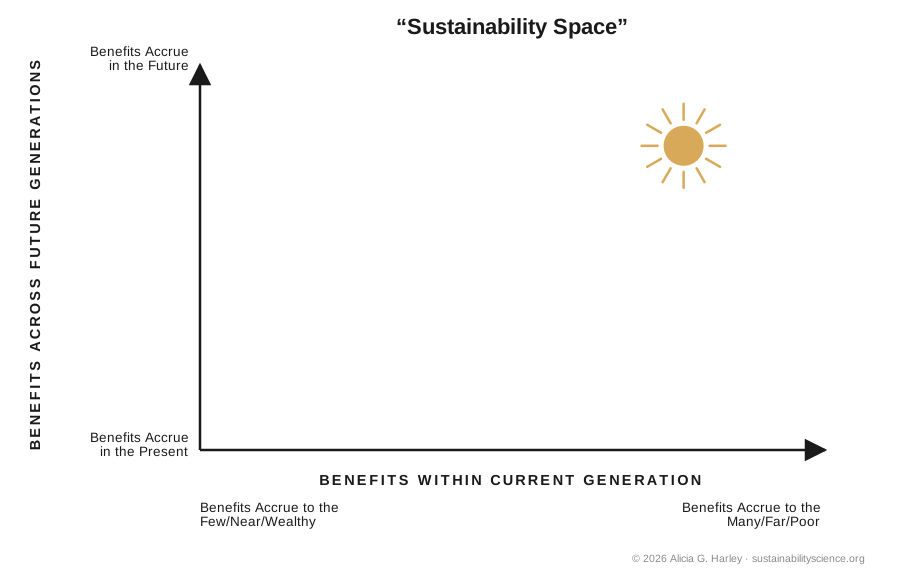
In teaching, public speaking, or even in casual conversations introducing someone to the topic of sustainable development, I have for many years used a very simple diagram that puts the two equity commitments of sustainability into one visual: one axis for how broadly the benefits of whatever we are looking at are shared within the current generation, and a second for how far those benefits extend to the generations that follow. I call it “sustainability space.” The term is a bit tongue in cheek, and I usually put quotation marks around it even when I am just talking, because it is not some kind of grand unifying theory, but rather what I have come to see as a powerful tool for explanation and even analysis.
-
The horizontal axis runs from “few” to “many.” It asks: within the current generation, how broadly are the benefits of whatever we’re looking at distributed? On the left, benefits accrue to the few, the near, the wealthy. On the right, to the many, the far, the poor.
-
The vertical axis runs from “present” to “future.” It asks: across generations, how are the benefits of whatever we’re looking at distributed over time? At the bottom, benefits accrue today. At the top, they also accrue to generations not yet born.
The goal of the figure is to ask where whatever you are working on (a policy, a technology, a program, a business idea, or something else) sits in this space, what trade-offs across the two dimensions are involved, and what changes or interventions might move it toward the upper right: increased intra- and inter-generational equity. For example, a carbon tax that makes cooking fuel unaffordable and a coal plant that electrifies poor villages can both look like progress if you evaluate the intervention on only one axis. The figure helps you see, from a sustainability perspective, what trade-offs you are making and what synergies might lead to win-wins against the dual equity commitments of sustainable development.
While I largely use this “sustainability space” figure qualitatively, as a thought exercise for thinking about a particular program, policy, technology, or intervention, scholarship over the past two decades has given us substantially more insight into how we might actually put hard numbers to “sustainability space.” I will return to the question of measurement in a future post scheduled for September 1. For now, I want to work through one technology in detail: solar-powered irrigation pumps.
Solar irrigation pumps: one technology, many places in “sustainability space”
Technologies make good examples to plot in “sustainability space” because we usually talk about them as if sustainability were a property of the physical technology itself: solar power is clean, coal plants are dirty, LED bulbs are efficient. In this example, we will instead look at a single technology, solar irrigation pumps, and untangle how the same physical technology can have very different intra- and inter-generational equity implications across different geographies and institutional conditions.
But first, let’s map a few familiar technologies into “sustainability space”:
-
Technologies for the rich: Many of the technologies that fill our homes in Boston or London or Hong Kong sit close to the origin. Espresso machines, robot vacuums, even dishwashers — these benefit wealthy people in the current generation, and their benefits for the most part don’t extend far across the income distribution or across generations.
-
Technologies for the poor: Other technologies sit farther to the right on the horizontal axis. A ceramic pot water filter is a cheap, accessible technology whose benefits accrue mostly to poor households in low-income countries today, with relatively little to offer wealthy users or future generations. Human-powered treadle pumps for lifting irrigation water and insecticide-treated bed nets to prevent malaria sit in the same territory.
-
Technologies for the future: A direct air capture plant, a machine that pulls CO₂ out of the atmosphere, sits nearly on the vertical axis itself. For the most part it produces nothing anyone can consume today, and its entire benefit, a more stable climate, accrues to generations not yet born. The Svalbard Global Seed Vault sits there too: it banks the world’s crop diversity against catastrophes that today’s depositors will likely never see.
And then there is the upper-right region, the sun in Figure 1, the win-wins: technologies whose benefits extend to the many in the current generation and to future generations. What lives there?
In my experience, the answer is almost never “a particular technology” alone. Where a technology sits in this space is determined both by its physical characteristics (what it is and how it works) and by the arrangements that surround it: who can afford it, who administers it, what infrastructure and complementary technologies it depends on, what policies widen or narrow access to it, and what the positive or negative externalities turn out to be in practice. (There is much more to say here; how the physical design of a technology and the institutions around it interact was the subject of my dissertation (Harley 2018) and of earlier work with colleagues on making technological innovation work for sustainable development (Anadon et al. 2016).) But the key takeaway is that the same physical technology can sit in very different places in “sustainability space,” and solar irrigation pumps in South Asia are a great example.
A few years ago, with colleagues in Pakistan, India, and Bangladesh, I spent a lot of time studying solar-powered irrigation pumps. Physically, these pumps do more or less exactly what diesel or electric pumps do: they lift water from a well or a pond to irrigate a crop. The differences lie in what powers them, what they cost, and when those costs are paid. Diesel pumps burn fossil fuel; solar pumps run on sunlight. In India alone, diesel irrigation pumps emit roughly 15 million metric tons of CO₂ a year (MNRE 2025); a solar pump, once installed, emits next to nothing. And because sunlight is free while diesel is not, solar is also substantially cheaper over the lifetime of the pump: payback periods of three to five years are common, and some farmers recoup the capital cost even faster (Bhattarai et al. 2025). The catch is that all of the costs of solar irrigation pumps arrive up front, and smaller and more vulnerable farmers usually cannot pay them.
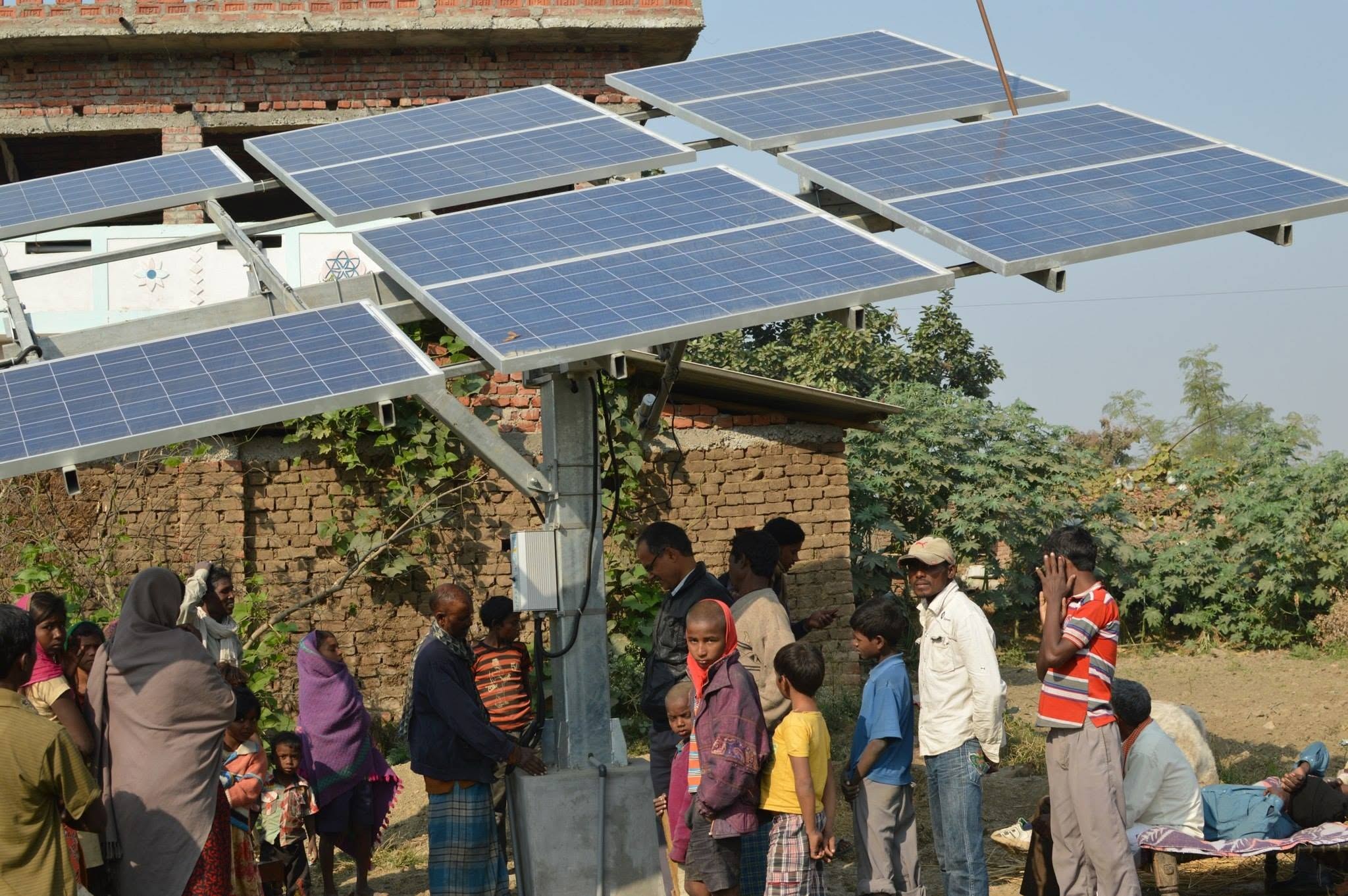
This is where thinking about this technology in terms of “sustainability space” becomes valuable. Over the past decade, the same technology for all intents and purposes (a groundwater pump and solar array) has been rolled out under (at least) four broad institutional arrangements in South Asia: Pakistan’s open market, India’s capital subsidies, Bangladesh’s water-selling enterprises, and, later within India, an institutional experiment in Gujarat built around a grid buy-back. Each of the four institutional designs turns out to land the same technology in a different place in “sustainability space.”
Pakistan: the open market
In Pakistan, a boom in solar irrigation was driven by market demand, largely without government subsidies. Solar pumps trickled into the country through the 2010s, but by the 2020s the trickle had become a flood. By the time of the 2024 agricultural census, solar had overtaken diesel as the largest source of pumping power in the country, with roughly 960,000 solar systems accounting for just over half of all farm pumping (Pakistan Bureau of Statistics 2026). The sharp increase in demand for solar irrigation was driven by several factors: a rise in grid electricity tariffs of roughly 155% in three years, a surge in diesel costs after the Pakistani government removed fuel subsidies, and Chinese solar-panel manufacturing overcapacity that cut world panel prices nearly in half (Shah 2025).
This has produced a market in which farmers buy pumps at full price from private dealers, overwhelmingly with their own money. Bank loans exist on paper, but collateral requirements and high interest rates keep farmers away, so in practice a farmer needs the upfront capital to pay the full cost of the system (IWMI 2021a; Akbar, Ringler, and Hafeez 2024). Before the boom, the majority of adopters were large farmers, with holdings above 25 acres (10 hectares), buying with their own funds (IWMI 2021a). (For context: 25 acres is a large farm in Pakistan. The average holding is 5.3 acres (2.1 hectares), and 59% of the country’s 11 million farms are under 2.5 acres (1 hectare) (Pakistan Bureau of Statistics 2026).)
There is no data on whether the 2023–24 wave of solar irrigation pump adoption has reached smaller and more vulnerable farmers (sadly the 2024 census reports pump counts by power source but not by farm size). There are, however, some hopeful signs: solar pump dealers in Punjab put the affordability threshold for individual purchase at roughly 10 to 12 acres (Akbar, Ringler, and Hafeez 2024), and below that there is anecdotal evidence of farmers buying panels jointly with neighbors, sharing them across families, and renting rather than owning (Reuters 2025). Those sharing arrangements are good news for intra-generational equity, but we do not know how widespread they are. In summary, on our map, solar irrigation in Pakistan does well on inter-generational equity (the emissions benefits are real) and poorly, at least so far, on intra-generational equity (for the most part medium and large farmers are the ones accessing the pumps). This means that the farmers who could most easily afford cheaper water got it first, while their poorer and more vulnerable neighbors keep paying for diesel, an arrangement that is plausibly increasing inequality within the current generation, though to my knowledge no one has measured this directly.
India: capital subsidies
In India, the central and state governments have subsidized the pumps since the early 2010s, first through state schemes, then nationally through the PM-KUSUM program launched in 2019, at rates that reach about 90% in some states. The targets are ambitious: PM-KUSUM calls for 1.4 million standalone solar pumps plus the conversion of 3.5 million existing grid-connected pumps to solar (Varshney et al. 2026). Adoption has grown, but on a very different trajectory from Pakistan’s. India had roughly 150,000 solar pumps at the end of 2017 and about 800,000 by the end of 2021 (Gupta 2019; Varshney et al. 2026); as of August 2025 the national program had installed about 850,000 standalone pumps and converted another 650,000 grid-connected pumps to solar (MNRE 2025). In absolute terms, adoption is substantial and accelerating. But India operates 25 to 30 million irrigation pumps (Varshney et al. 2026), so after fifteen years of subsidies solar still accounts for only about 5% of the stock, while unsubsidized Pakistan went from a trickle to half of all farm pumping in about three years.
The difference is mostly about what fuel solar replaces. Around 85% of Pakistan’s pumps ran on increasingly expensive diesel, so a solar system bought at crash prices paid for itself within a year or two (Jamil et al. 2025). Roughly two-thirds of India’s pumps instead run on farm electricity that states price far below the cost of supplying it, and in several states give away free; one recent study measured electric pumping at about 10 cents an hour against a dollar to a dollar-fifty for diesel (Kishore et al. 2023). For most Indian farmers, solar therefore saves little compared with the nearly free electricity they already use. The minority who still run diesel pumps would gain the most from switching, but they face a second obstacle: domestic-content rules meant to protect India’s solar manufacturers require that subsidized pumps be built with domestically made panels, which cost well above the world price (IEEFA 2022).
In principle, a subsidy as steep as India’s should pull the technology to the right in “sustainability space” (toward greater intra-generational equity). In practice, it has mostly not. Farmers wait in lotteries and on waiting lists for rationed subsidy slots rather than self-financing (likely slowing overall rates of adoption) (Gupta 2019). Moreover, the subsidies flow disproportionately to larger, better-off farmers. In Rajasthan, the eligibility criteria for the solar pump subsidy themselves exclude poor farmers, with no rule-breaking involved. To qualify for a subsidized unit, a farmer has to own a minimum (not a maximum) amount of land, have built a farm pond (itself an investment of thousands of dollars), have installed drip irrigation, and still pay a substantial share of the pump’s cost. Farmers who can clear all of those bars are by definition not poor: in the field study, not a single pump owner was a small or marginal farmer (Kishore, Shah, and Tewari 2014). In Bihar, where I saw the program up close during my dissertation fieldwork, the rules were simply ignored. Bihar’s early scheme subsidized pumps at 90%, with eligibility capped at five acres of land. Yet among the seven randomly selected subsidy recipients I interviewed, the average landholding was ten acres, double the subsidy cap (Harley 2018).
Worse, the scheme was putting pumps in the hands of exactly the farmers who would benefit least from them: those who already had, or would soon have, cheap flat-rate grid electricity. One $4,000 subsidized solar unit stood unused beside a borewell that already had an electric pump, wired to the grid at a flat rate of about three dollars a month. Its owner was wealthy and connected: he told me that Bihar’s chief minister (the equivalent of a state governor in the US) had once come to sit with his family after his father’s death, and in a state of well over 100 million people the chief minister does not do that for the average small farmer. He preferred his electric motor for a simple reason: the solar unit provided through the subsidy program was small, and it pumped significantly less water per hour. But he liked the look of the panels, so he fitted a wooden bed beneath them and used them for shade. An expensive umbrella (Harley 2018).
So where does India’s subsidy arrangement land in “sustainability space”? On inter-generational equity, the gains are real but modest: every subsidized pump cuts emissions, but after fifteen years solar remains a small fraction of India’s pump stock. On intra-generational equity, the arrangement has barely moved at all: the subsidies flow disproportionately to larger, better-off farmers, and in the districts where solar is most profitable, one evaluation concludes, wealthier farmers “are likely to adopt solar pumps even without subsidies” (Gupta 2019). Public money meant to move the technology to the right has mostly gone to farmers who could have bought pumps anyway.
Bangladesh: selling water instead of pumps
The third case, Bangladesh, has taken a different route: rather than subsidizing farmers to own solar pumps, the government set out to sell poor farmers the water itself. The institution behind this is IDCOL, the Infrastructure Development Company Limited, the state-owned development financier behind Bangladesh’s rural solar home system program, which brought solar electricity to millions of off-grid households through the 2000s and 2010s. For irrigation, IDCOL does not subsidize farmers at all. Instead it finances small local enterprises (roughly half the cost as a grant, a third as a low-interest loan, the rest as the enterprise’s own equity) to install larger shared pumps and sell irrigation water to surrounding farmers as a service (Mitra et al. 2024).
The logic of selling water rather than pumps requires knowing how irrigation already works in Bangladesh, and in much of South Asia, for small and vulnerable farmers. Where landholdings are tiny, most farmers do not own a well. A well and pump are a lumpy investment sized for far more land than a half-hectare plot, so the farmers who own them are the ones with more land and money, and everyone else buys water from them, paying a neighboring pump owner by the hour or by the season to irrigate. Water markets of this kind are how the majority of Bangladesh’s smallholders already get their irrigation. IDCOL’s design accepts that reality instead of fighting it: rather than trying to turn every smallholder into a pump owner, it finances the water seller and makes the water seller solar. An earlier attempt at the ownership route shows why this matters: when a different agency, the Bangladesh Rural Electrification Board, offered farmer-owned solar pumps, it placed 150 against a target of 2,000 (Mitra et al. 2024). A larger shared pump serving many small plots spreads the high capital cost over far more irrigated land, and it shifts the investment risk from farmers onto the sponsoring enterprise. The farmer does not need to buy a pump, win a subsidy slot, or qualify for a loan; she just buys water, at rates 20–30% below what buying from a diesel pump owner costs her. And the farmers this reaches really are small: the water buyers in the field studies cultivate about half a hectare on average (Alam et al. 2025). The near-zero running cost of solar belongs to the enterprise, not the farmer. She pays for every irrigation, so she keeps a reason to use water sparingly, and the enterprise, which wants one pump to serve as many paying farmers as possible, has no reason to waste water either. I return to this incentive below.
The model is not perfect, and its evaluators are realistic about the trade-offs: the largest benefits accrue to the sponsoring enterprises rather than the farmers, an unmonitored sponsor could become the local water monopolist, and adoption has remained far smaller than IDCOL hoped. By 2023, roughly 2,800 solar irrigation pumps were operating in Bangladesh, about 1,500 of them financed by IDCOL, against an original target of 50,000 pumps that has since been revised down to 10,000 by 2027 (IWMI 2021b; Mitra et al. 2024; Alam et al. 2025). IDCOL’s is also not Bangladesh’s only route to solar irrigation: government agencies in the Barind region run their own community solar pumps and sell water to farmers through prepaid cards, a program that accounts for most of the country’s remaining units (Mitra et al. 2024). The two programs share the design that matters for equity: farmers buy water, not pumps, so even the smallest farmers can benefit. Where they differ is in who controls the pump, and each has its own risk: the Barind pumps depend on continuing subsidies and often sit on larger farmers’ land, where local elites can end up controlling the service, while IDCOL’s version needs no ongoing subsidy but leaves the largest gains with the sponsoring enterprises (Mitra et al. 2024). It is the water-selling design itself that extends solar irrigation to farmers who could never buy a pump, meaningfully improving intra-generational equity.
The groundwater problem
So far in this discussion, we have treated inter-generational equity, the vertical axis, as if it were mostly about reducing carbon emissions and thus mitigating the impacts of climate change on future generations. But solar pumps also affect the rate of depletion of another resource future generations will depend on: groundwater. Because a solar pump costs almost nothing to run once it is installed, farmers no longer have an incentive to pump only as much as they need; in effect, an additional unit of water costs nothing. Researchers have warned for years that near-free pumping would accelerate groundwater depletion wherever water goes unpriced (Balasubramanya et al. 2024), and recent research backs up this concern. In Pakistan’s lower Indus, researchers compared solar farms with otherwise similar diesel farms nearby, a matched comparison that is the closest thing to a controlled experiment you can run on working farms: the solar farms pumped roughly a quarter more water (Jamil et al. 2025). In Rajasthan’s groundwater-dependent districts, solar adopters’ water use also rose by roughly a quarter (Gupta 2019). This changes where these cases sit in “sustainability space.” The same pump that improves inter-generational equity by cutting emissions can worsen inter-generational equity by drawing down the water table that the next generation of farmers will depend on.
In contrast, under Bangladesh’s model the incentive to over-pump is weak, because the farmer pays for every irrigation while the enterprise earns by serving more farmers, not by pumping more water. Field measurements match this logic: solar plots in Bangladesh use no more water than diesel plots (Alam et al. 2025), though the study’s authors caution that irrigation there is priced by area rather than by volume, and that a small rise in dry-season rice area deserves watching. The design does not reduce groundwater extraction; farmers still pump what their crops need. What it prevents is the additional pumping that free solar energy otherwise invites.
Gujarat: an institutional experiment
The fourth case is not a fourth country: it is a deliberate experiment inside India’s own rollout. Gujarat, a state in western India, pairs some of the country’s most depleted aquifers with a long history of experimenting with water institutions, and it is where a group of water researchers had been arguing for years that the way to fix solar’s groundwater problem was to change what farmers are paid, not what they pump (Shah, Durga, and Verma 2014; Shah et al. 2018). In 2015, that group piloted the idea with a six-farmer cooperative in the village of Dhundi: connect the solar pumps to the electricity grid, and buy the farmers’ surplus power at a guaranteed price. In 2018, the state government scaled the design into the Suryashakti Kisan Yojana (SKY), the world’s first large-scale grid-connected solar irrigation scheme (Varshney et al. 2026). A farmer in SKY gets a subsidized solar array tied to the grid, and whatever power she does not use for pumping, the utility buys. (Arrangements like this are called feed-in tariffs; the same instrument drove rooftop solar booms in Germany and elsewhere.)
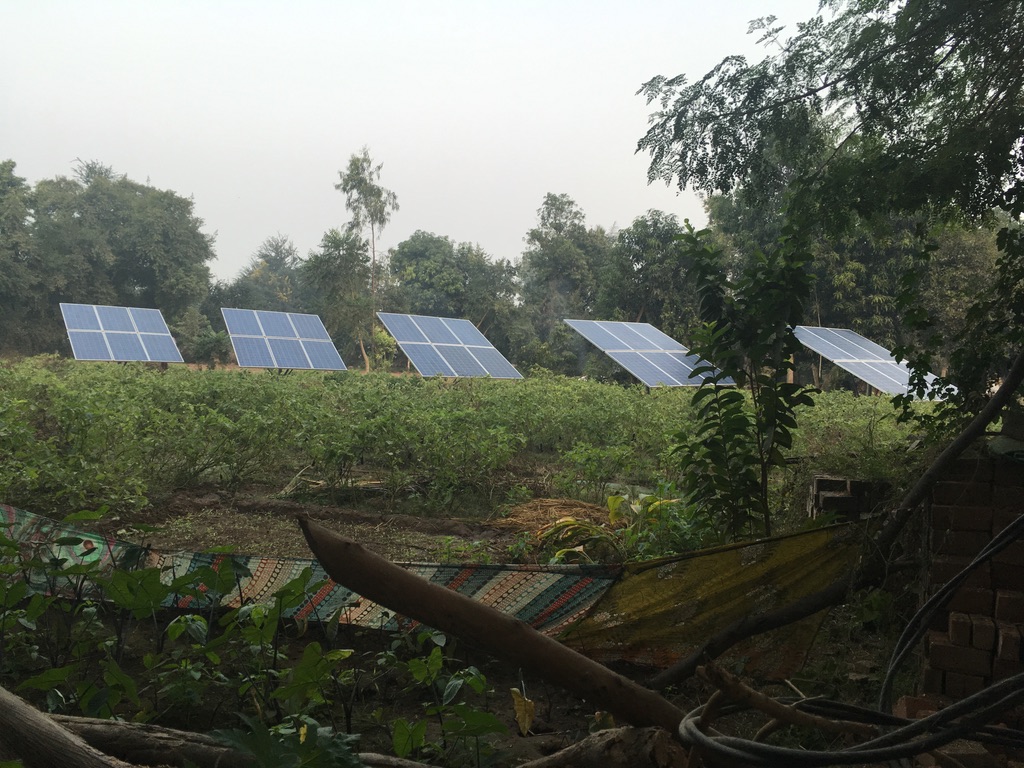
The buy-back price gives the water left in the ground a value: an hour not spent pumping is an hour of solar power the farmer can sell back to the grid instead. In the recent evaluation of the scheme, farmers’ net earnings (power sales plus savings on their own electricity bills, after loan repayments) averaged about $260 (₹22,000) a year, roughly two-fifths of an average Gujarati farmer’s crop income. Meanwhile, their energy use for groundwater extraction grew significantly more slowly than that of comparable farmers outside the scheme, an effect confined to the dry season, when it matters most (Varshney et al. 2026). Because the surplus power is captured rather than wasted, a grid-connected pump also delivers more than twice the emissions benefit of an off-grid one.
What does SKY mean for intra-generational equity? Less than one might hope, because SKY was never designed as an access program. It can only enroll farmers who already own a grid-connected electric pump, and Gujarat’s poorest farmers never had a grid connection to begin with; they sit outside the scheme’s universe entirely. Within that universe, the record is actually respectable: participation rises with landholding, yet marginal farmers still make up about 40% of SKY’s beneficiaries (Varshney et al. 2026), a substantial share given that marginal farmers are the least likely to own grid-connected pumps in the first place. In short, SKY raises incomes and protects groundwater for farmers already inside the electricity system; it does not, and cannot, reach the farmers who were never connected. SKY remains a state-level experiment rather than an all-India program, with about 4,300 farmers enrolled, but its grid-connected logic is spreading: India’s national PM-KUSUM scheme now promotes solarizing entire rural electricity feeders, so that every farm pump on a local line runs on solar power by day without each farmer needing panels of their own (Varshney et al. 2026).
Solar irrigation under four different institutional arrangements
| Pakistan | India | Bangladesh | Gujarat, India (SKY feed-in tariff) | |
|---|---|---|---|---|
| The arrangement | Open market | Capital subsidies | Water sold as a service | Grid buy-back |
| Who pays for the pump | Farmer, full price, in cash | Government pays up to 90%; farmer the rest | Local enterprise, financed by IDCOL | Farmer, with subsidy and loan, grid-tied |
| How a small farmer benefits | Sharing or renting panels (anecdotal) | Rarely: slots go to larger farmers | Buys water per irrigation, no capital needed | Rarely: must already own a grid-connected pump |
| Groundwater use | Solar adopters pump ~25% more than diesel farms | Solar adopters’ water use up ~25% (Rajasthan) | No increase: farmers pay per irrigation | Growth slowed: selling power pays better than pumping |
| Adoption to date | ≈960,000 pumps (>50% of farm pumping, in ~3 years) | ≈1.5 million pumps (~5% of pump stock, over 15 years) | ≈2,800 pumps (each serves many buyers) | ≈4,300 pumps (one per farmer) |
Table 1: The same technology under four institutional arrangements.
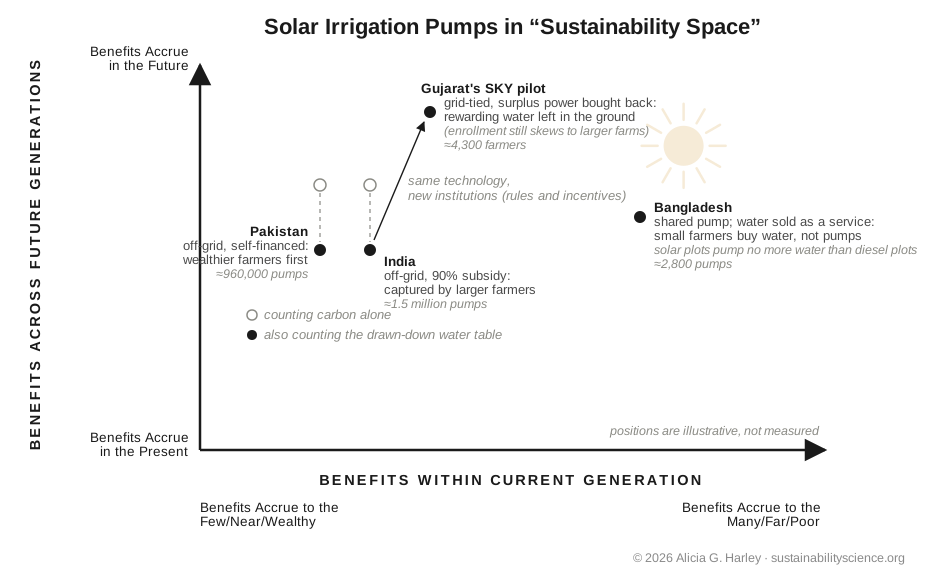
The same physical pump, under four different institutional arrangements, lands in four different places in “sustainability space,” and reshaping the rules and incentives around it, as Gujarat did, can change where it lands. In Gujarat’s case, institutions (rules and incentive structures) were redesigned to reduce threats to the groundwater resources that future generations will depend on. But it is not always the institutions that need redesign. The physical design of the technology matters too. In Nepal, small farmers could not devote an entire well to a solar pump: most own only one well, and on cloudy days they still need to irrigate. Engineers designed a solar irrigation pump that allowed a farmer to switch quickly between diesel and solar, so smallholders can run their well on solar when the sun is shining and still irrigate using diesel when clouds or fog (a frequent occurrence in Nepal’s terai) make the solar pump inoperable (Harley 2018). The key takeaway is that whether a technology is pro-poor or pro-future-generations depends on both physical and institutional choices.
Scale matters too, and so far good design and large scale have not appeared in the same place. Pakistan’s market has moved the technology faster than any subsidy program anywhere (Shah 2025), with the emissions gains to match; and because every pump replaced is one less diesel engine running, less local air pollution as well. But Pakistan has no institutional design to slow the overpumping of groundwater, and no real policy structure to help the poorest and most vulnerable farmers benefit from solar irrigation. Unless it adopts something like Gujarat’s incentive to leave water in the ground, the scale of solar adoption could have major implications for groundwater in an already water-stressed region (Balasubramanya et al. 2024; Jamil et al. 2025). India’s subsidies have led to far slower adoption. That is largely pure economics (farmers pay far less to irrigate in much of India because states price farm electricity near zero), but the design and rollout of the subsidy programs themselves have also slowed adoption (Gupta 2019; IEEFA 2022). Bangladesh’s water-service model and Gujarat’s buy-back experiment do the most for groundwater, and in Bangladesh’s case for vulnerable farmers as well, but both are orders of magnitude smaller, covering a few thousand pumps each. No arrangement has yet delivered scale, groundwater protection, and access for the most vulnerable farmers at the same time.
On access for poor and vulnerable farmers in particular, there is experimental evidence for how hard the problem is. In Nepal, researchers designed an experiment to test whether reshaping incentive structures could help poor and vulnerable farmers benefit from solar irrigation pumps. They offered smallholder farmers loans and pay-as-you-go plans on top of a 60% subsidy. Demand doubled, but the profile of the buyers did not change: they remained larger-holding farmers from dominant castes. The exception was the impact of the project on gender equity. Women were offered an extra 10% subsidy, conditional on the land where the pump would be installed being titled in the woman’s name, and women went on to make more than half of all purchases in the study (Bhattarai et al. 2025). The land-title requirement makes purely nominal participation costly, though the study could not observe whether control of the pump, or of the income it generates, followed formal ownership. Despite the good news on gender, the overall lesson stands: designing institutions that allow vulnerable groups to afford capital-intensive technologies is really hard!
In summary, the two axes of “sustainability space” are a visual reminder of the two equity commitments of sustainable development. I have used it for years as a way to introduce newcomers to the concepts and goals of sustainable development at the most basic level, but also more analytically, as in the solar irrigation case presented here, to really tease out the complexities, trade-offs, and synergies for intra- and inter-generational equity when studying interventions in complex nature-society systems. As the solar example shows, it’s almost never as straightforward as you think.
I’d be very curious to hear whether “sustainability space” is useful to others, especially leaders and practitioners working through the task of supporting sustainable development. If you try plotting a technology, policy, or program you know well, I would love to hear where it lands, and what you think it would take to move it towards the sunshine.
References
Akbar, Z.M., C. Ringler, and M. Hafeez. 2024. “Business and Finance Models for Increased Sustainability and Equity of Solar-Powered Irrigation in Pakistan.” IWMI Blog, International Water Management Institute, December 5, 2024.
Alam, M.F., A. Mitra, S. Mahapatra, P. Pavelic, M.-C. Buisson, et al. 2025. “Bangladesh’s Groundwater Trade-offs from Decarbonizing Irrigation through Solar-Powered Pumps.” Nature Water 3: 1411–1423.
Anadon, L.D., G. Chan, A.G. Harley, K. Matus, S. Moon, S.L. Murthy, and W.C. Clark. 2016. “Making Technological Innovation Work for Sustainable Development.” Proceedings of the National Academy of Sciences 113(35): 9682–9690.
Balasubramanya, S., D. Garrick, N. Brozović, C. Ringler, E. Zaveri, et al. 2024. “Risks from Solar-Powered Groundwater Irrigation.” Science 383(6680): 256–258.
Bhattarai, D., R. Fishman, N. Lamichhane, and A. Mukherji. 2025. “Targeted Finance and the Adoption of Solar Irrigation by Smallholder and Women Farmers.” Energy Policy 202: 114569.
Chasek, P.S., and L.M. Wagner. 2016. “Breaking the Mold: A New Type of Multilateral Sustainable Development Negotiation.” International Environmental Agreements: Politics, Law and Economics 16(3): 397–413.
Gupta, E. 2019. “The Impact of Solar Water Pumps on Energy-Water-Food Nexus: Evidence from Rajasthan, India.” Energy Policy 129: 598–609.
Harley, A.G. 2018. “Why Does Technology Fail to Benefit the Poorest Farmers? A Sociotechnical Approach to the Study of Innovation and Poverty.” PhD dissertation, Harvard University.
IEEFA. 2022. How Import Restrictions on Modules Will Push Solar Energy Tariffs in India. Institute for Energy Economics and Financial Analysis.
IWMI. 2021a. Solar Irrigation in Pakistan: A Situation Analysis Report. Colombo: International Water Management Institute.
IWMI. 2021b. Solar Irrigation in Bangladesh: A Situation Analysis Report. Colombo: International Water Management Institute.
Jamil, M.K., W.J. Smolenaars, B. Ahmad, S. Dhaubanjar, W.W. Immerzeel, et al. 2025. “The Effect of Transitioning from Diesel to Solar Photovoltaic Energy for Irrigation Tube Wells on Annual Groundwater Extraction in the Lower Indus Basin, Pakistan.” Journal of Agriculture and Food Research 20: 101799.
Kamau, M., P. Chasek, and D. O’Connor. 2018. Transforming Multilateral Diplomacy: The Inside Story of the Sustainable Development Goals. New York: Routledge.
Kishore, A., M. Gupta, F. Dizon, and P. Kumar. 2023. “An Assessment of Community-Led Lift Irrigation Systems in Jharkhand, India.” Policy Research Working Paper 10439. Washington, DC: World Bank.
Kishore, A., T. Shah, and N.P. Tewari. 2014. “Solar Irrigation Pumps: Farmers’ Experience and State Policy in Rajasthan.” Economic and Political Weekly 49(10): 55–62.
Mitra, A., M.-C. Buisson, A.Z. Osmani, and A. Mukherji. 2024. “Unleashing the Potential of Solar Irrigation in Bangladesh: Key Lessons from Different Implementation Models.” Environmental Research Letters 19(1): 014024.
Nilsson, M., D. Griggs, and M. Visbeck. 2016. “Map the Interactions between Sustainable Development Goals.” Nature 534: 320–322.
MNRE (Ministry of New and Renewable Energy). 2025. “PM-KUSUM Scheme Factsheet.” New Delhi: Press Information Bureau, Government of India, August 14, 2025.
Pakistan Bureau of Statistics. 2026. 7th Agricultural Census 2024. Islamabad: Government of Pakistan.
Reuters. 2025. “How Solar-Powered Farming Is Digging Pakistan into a Water Catastrophe.” Published in Dawn, October 2, 2025.
Shah, J. 2025. “The Perfect Storm Fueling Pakistan’s Solar Boom.” Washington, DC: World Resources Institute, October 1, 2025.
Shah, T., N. Durga, and S. Verma. 2014. “Karnataka’s Smart, New Solar Pump Policy for Irrigation.” Economic and Political Weekly 49(48).
Shah, T., A. Rajan, G.P. Rai, S. Verma, and N. Durga. 2018. “Solar Pumps and South Asia’s Energy-Groundwater Nexus: Exploring Implications and Reimagining Its Future.” Environmental Research Letters 13(11): 115003.
United Nations. 2015. “MY World: The United Nations Global Survey for a Better World.” New York: United Nations.
Varshney, D., A. Mukherji, K. Sharma, A. Banerjee, and A. Sikka. 2026. “Solar Irrigation and Just Energy Transitions in Agriculture: Insights from Evaluation of Gujarat’s SKY Program.” Energy Policy 210: 114999.
WCED (World Commission on Environment and Development). 1987. Our Common Future. Oxford: Oxford University Press.