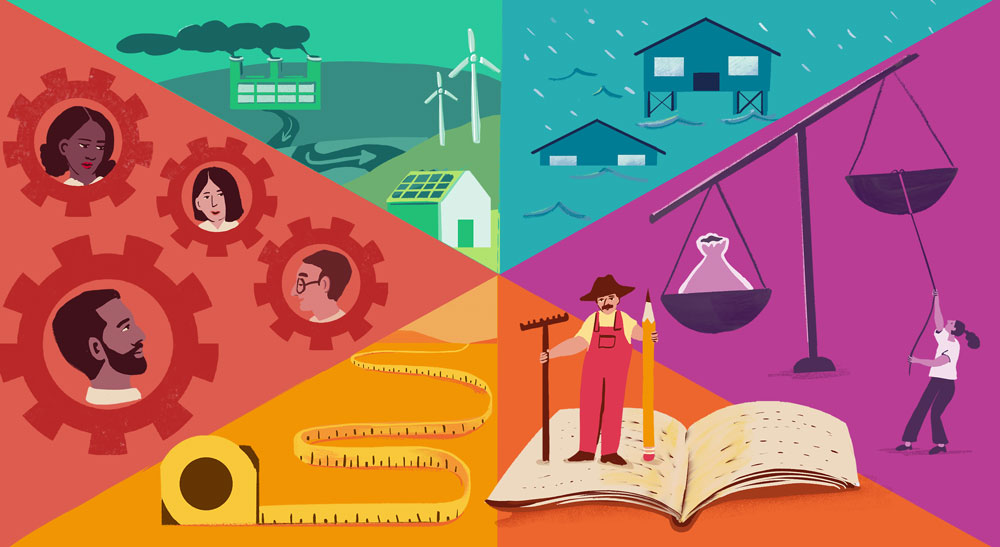
Alicia Harley is a Senior Research Fellow in the Sustainability Science Program at Harvard Kennedy School, where she leads the Capacity Building for Sustainable Development (C4SD) initiative. Her research articulates six strategic capacities that enable the pursuit of sustainable development under deep uncertainty: the capacities to promote equity, measure progress, adapt to shocks and surprises, transform development pathways, govern cooperatively, and link knowledge with action. She is currently writing a book integrating scholarship and practice on building and maintaining the capacities needed to foster sustainable development in the face of uncertainty and entrenched interests.
The C4SD initiative combines insights from research and real-world experience to help put sustainability into practice. It runs a bi-weekly virtual seminar series bringing together leading scholars and practitioners to share lessons on building capacity for sustainable development. The seminars are open to the public, and recordings of past sessions are available online.
Her empirical work on the capacity to promote equity centers on agricultural innovation systems in South Asia, examining how the sociotechnical design of technologies and institutions can be reoriented so that the poorest and most vulnerable farmers benefit from new technologies. Related projects include a multi-village study of smallholder technology access in Bihar, India; a cross-state comparison of drip irrigation policy in India; and a cross-national comparison of solar irrigation policy across Bangladesh, India, Nepal, and Pakistan. She also leads a project examining the tensions between adaptation and transformation in the US Virgin Islands.
She is editor of sustainabilityscience.org, an open-access platform for teaching materials and scholarship in sustainability science, and serves as a Councilor on the Board of Directors of the National Sustainability Society. She holds a PhD in Public Policy from Harvard.
Selected publications
Building Capacities for Sustainable Development — a series of working papers with William C. Clark, forming the foundation of a forthcoming book.
- Harley, Alicia G. and William C. Clark. 2025. Building Capacity to Measure Sustainability: Lessons from Scholarship and Practice. Sustainability Science Program Working Paper 25-01.
- Harley, Alicia G. and William C. Clark. 2025. Building Capacity to Adapt Development Pathways to Protect Human Well-being in the Face of Shocks. Sustainability Science Program Working Paper 25-02.
- Harley, Alicia G. and William C. Clark. 2025. Building Capacity to Transform Unsustainable Development Pathways into Sustainable Ones. Sustainability Science Program Working Paper 25-03.
- Harley, Alicia G. and William C. Clark. 2025. Building Capacity to Promote Equity within and among Generations. Sustainability Science Program Working Paper 25-04.
- Harley, Alicia G. and William C. Clark. 2025. Building Capacity to Govern Cooperatively in Pursuit of Sustainable Development. Sustainability Science Program Working Paper 25-06.
Other selected work
- Harley, Alicia G. 2026. Our Posterity: The Human Rights of Future Generations. In Self-Evident Truths: The 250-Year Pursuit of Human Rights in the United States of America, edited by Mathias Risse. Carr-Ryan Center for Human Rights, Harvard Kennedy School.
- Harley, Alicia G. and Hannah Wexner. 2022. The Struggle for Sustainable Development in Appalachia’s Mineral Rich Mountains. M-RCBG Associate Working Paper 184. A teaching case on power, resistance, and the pursuit of sustainability in Central Appalachia.
- Clark, William C. and Alicia G. Harley. 2020. Sustainability Science: Towards a Synthesis. Annual Review of Environment and Resources 45: 331–386.
- Harley, Alicia G. 2018. Why Does Technology Fail to Benefit the Poorest Farmers? A Sociotechnical Approach to the Study of Innovation and Poverty. Doctoral dissertation, Harvard University. [Summary]
- Anadon, Laura Diaz, Gabriel Chan, Alicia G. Harley, Kira Matus, Suerie Moon, Sharmila L. Murthy, and William C. Clark. 2016. Making Technological Innovation Work for Sustainable Development. PNAS 113 (35): 9682–9690.